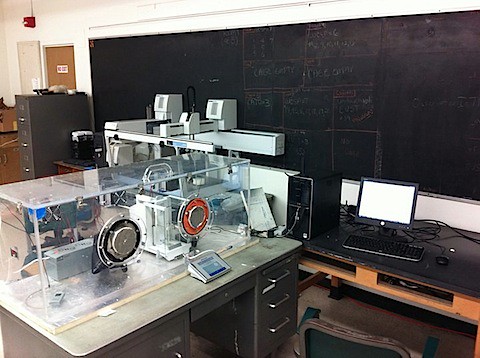
While there are still things to do -- such as transporting massively heavy granite balance table to the lab (via a door blocked by construction and a forklift and somehow squeezing into the doorways of the Microbiology building) -- the RHX Dating lab is coming together and we are beginning to conduct our experiments. This week we had a TA Instruments VTI-SA vapor sorption analyzer and a Q50 thermogravimetric analyzer (TGA) installed into the IIRMES lab. The installations went smoothly though we lacked the giant balance table and had to use a bench top that is a bit less than optimal.
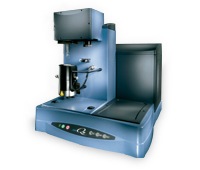 The Q50 is a nice little TGA. Completely controlled via Windows (man, I do not miss the SCO Unix OS and software that ran on the Perkin Elmer TGA we had back at the U.W.) with a nice 1gm maximum sample size and a furnace that covers 0-1000 degrees C. My primary impetus for purchasing the TGA is for determining firing temperatures on prehistoric ceramics to see how this factor may impact rehydroxylation processes. From my initial test of a Mississippian sherd from Arkansas (Rose Mound), the unit will be ideal -- I got a clear signal at ca. 610 degree C that showed a massive loss of weight that is the result of additional firing of the clay beyond the original firing temperature. I'll be running more tests, of course. And I need to do some work on the various exceptions of clay composition and firing effects.
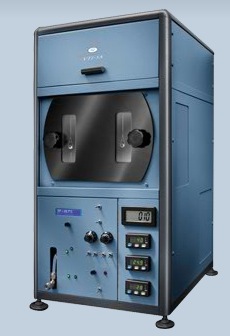 The vapor sorption analyzer is a 1950s looking machine but has a solid Windows based interface for doing all of the actual work. Basically it consists of an ultra balance with two sample holders that are suspended in a finely controlled temperature and humidity environment. For our purposes, much of the ability (to change temp and humidity in a dynamic way) of the VTI-SA are overkill since our use basically consists of making mass measures in a constant temperature and humidity -- but the precision of this instrument will give us an ability to explore some of the boundaries of the overall method. We are now working on our measurement protocols so we can start running sherds -- Ill probably go in tomorrow to start a run. Can't wait...