A long time ago, in a galaxy far, far away (well, it was Seattle) there were a group of students in an archaeology graduate program (at the University of Washington) who shared a particular kind of training offered by a curmudgeonly but deeply logical professor (Robert C. Dunnell). These students all spent significant amounts of time preparing proposals for conducting their doctoral research. The challenge they faced was dictated by their advisors: conduct archaeological research that will generate falsifiable answers to questions about the archaeological record. This task is harder than it seems since the first task, asking appropriate questions, has been a quagmire for archaeologists since the origins of the discipline. Yet, to finish their PhDs in this particular program, these students naively took on this challenge and spent years (in many cases) developing their proposals.
In the end, most of the students finished their PhDs by conducting the research that was proposed. The resulting tomes can be found in the UMI repository and in some cases as published volumes. One of the important contribution of their work, however, isn't entirely in the end product. In the end, the results of the research are all determined by the questions being asked and the proposals generated dictating the research design. These documents rarely see the light of day in a publication sense yet are the fundamental basis upon which data are generated and conclusions drawn. Indeed, not all of the students completed their research (largely due to the difficulties involved in actually making the required measurements) but even so, the proposals for the work stand alone as significant accomplishments. In science, asking the right questions is the 99% of the problem.
With Terry Hunt (University of Hawai'i) and Sarah Sterling (Portland State University), I put together an edited volume of these proposal. This book was published back in 2001 by Bergin and Garvey. You can still buy it new off of Amazon.com (http://www.amazon.com/Posing-Questions-Scientific-Archaeology-Millennium/dp/0897897536) for an absurd amount of money ($119) or you can get it used for as little as $10.00. You can even preview the book at books.google.com
The table of contents of Posing Questions.:
Preface
Chapter 1: Posing Questions for a Scientific Archaeology - Terry L. Hunt, Carl P. Lipo and Sarah L. Sterling
Chapter 2: Groundstone Wedge Tool Form and Function: Experimental Analyses in Northern South American “Axes” - Kimberly D. Kornbacher
Chapter 3: The Engineering and Evolution of Hawaiian Fishooks - Michael T. Pfeffer
Chapter 4: Projectile Point Variation in Evolutionary Perspective: An Example from the Central Mississippi River Valley - Kris H. Wilhelmsen
Chapter 5: Social Complexity in Ancient Egypt: Functional Differentiation Reflected in the Distribution of Standardized Ceramics - Sarah L. Sterling
Chapter 6: Community Structures in Late Mississippian Populations of the Central Mississippi Valley - Carl P. Lipo
Chapter 7: Dietary Variation and Village Settlement in the Ohio Valley, A.D. 400 - 1650 - Diana M. Greenlee
Chapter 8: Resource Intensification and Late Holocene Human Impacts on Pacific Coast Bird Populations: Evidence from the Emeryville Shellmound Avifauna - Jack Broughton
Chapter 9: Evolutionary Bet-Hedging and the Hopewell Cultural Climax - Mark E. Madsen
Index
Contributors
Given that Terry Hunt, Sarah Sterling and I hold the copyright, I'm going to link a PDF of this volume. I am releasing this under a Creatives Commons Licence. You can download the book here (about 17 megs).
This work is licensed under a Creative Commons Attribution-NonCommercial-ShareAlike 3.0 Unported License


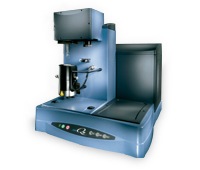 The Q50 is a nice little TGA. Completely controlled via Windows (man, I do not miss the SCO Unix OS and software that ran on the Perkin Elmer TGA we had back at the U.W.) with a nice 1gm maximum sample size and a furnace that covers 0-1000 degrees C. My primary impetus for purchasing the TGA is for determining firing temperatures on prehistoric ceramics to see how this factor may impact rehydroxylation processes. From my initial test of a Mississippian sherd from Arkansas (Rose Mound), the unit will be ideal -- I got a clear signal at ca. 610 degree C that showed a massive loss of weight that is the result of additional firing of the clay beyond the original firing temperature. I'll be running more tests, of course. And I need to do some work on the various exceptions of clay composition and firing effects.
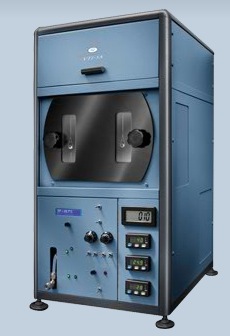 The vapor sorption analyzer is a 1950s looking machine but has a solid Windows based interface for doing all of the actual work. Basically it consists of an ultra balance with two sample holders that are suspended in a finely controlled temperature and humidity environment. For our purposes, much of the ability (to change temp and humidity in a dynamic way) of the VTI-SA are overkill since our use basically consists of making mass measures in a constant temperature and humidity -- but the precision of this instrument will give us an ability to explore some of the boundaries of the overall method. We are now working on our measurement protocols so we can start running sherds -- Ill probably go in tomorrow to start a run. Can't wait...