
Showing posts with label archaeological science. Show all posts
Showing posts with label archaeological science. Show all posts
Monday, October 26, 2015
Evolutionary Research and Graduate Programs at Binghamton University... Interested?
Now that I have landed at Binghamton University, I am looking forward to working with graduate students who are interested in pursuing a PhD in evolution-based research focusing on the archaeological record and/or historical and contemporary data. Ideal students would have an interest in quantitative methods, programming and other kinds of tools that enable evolutionary modeling (e.g., simulation). Some experience in archaeometry, artifact analysis, phylogenetic analyses, materials analyses, geochronology, GIS, remote sensing, paleoenvironmental analyses, spatial studies, statistics, etc. would be beneficial though training in these areas is certainly available at Binghamton. Fundamentally, I am looking for students who are passionate about science and share my passion for figuring out why the human past unfolded as it did.  Binghamton University offers a remarkable array of resources that can provided a background and training in evolutionary studies. Within the Anthropology Department, the PhD program is a general sort with the usual exposure to anthropological research. However, in my own courses I teach all my classes within a science- and evolutionary based framework. In addition to my own classes, opportunities exist within the department to gain training from other faculty. For example, Koji Lum runs the Laboratory of Evolutionary Anthropology and Health (LEAH) and does research that emphasizes the Pacific islands, a region of particular interest to me. David (Andy) Merriwether runs an ancient DNA laboratory and is doing amazing work studying past populations of camelids. The potential for collaborative work and cross-training in these laboratories is exceptional. In the area of paleoanthropology, Rolf Quam is studying human evolution and has been active at Atapuerca in northern Spain.
Outside the Department there is an even greater array of opportunities for training in evolution. First, we have EVoS, the Evolutionary Studies Program. EVoS is an interdisciplinary program that brings together faculty from across the University who are interested in evolutionary theory and evolutionary science. EVoS offers classes in evolutionary thinking and has a prominent lecture series that brings researchers from around the world to present on evolution-based research. The Director of EVoS is David Sloan Wilson, who is well-known for his evolutionary theory advocacy, research into the dynamics of group-level behavior and applications of evolutionary thinking to contemporary issues in communities. Wilson is a remarkable thinker who is fearless in his approach to using evolution in the study of human populations.
Second, Binghamton has the newly established Center for Collective Dynamics of Complex Systems, CoCo. CoCo is an interdisciplinary program that fosters collaborations among faculty who are interested in studying complexity. Many of the CoCo researchers make use of evolutionary dynamics as a means of studying change in populations and their foci complement that of EVoS quite nicely.
In terms of science-based analyses of the archaeological record and in addition to resources in Geological Sciences, Binghamton has the Advanced Diagnostics Laboratory (ADL). ADL is a centrally managed laboratory with a diverse array of instruments that are suitable for studying physical properties of material culture. These instruments will play an important role in generating data on variability in artifact performance as it varies over space and time.
In the realm of field research, we are currently putting into place a program in remote sensing and geospatial research through a collaboration with Geography, Geology, the MA program in Public Archaeology and Environmental Studies. This collaboration will bring together tools and instruments for mapping landscapes at the surface and subsurface. We are in the process of assembling a suite of fixed wing UAS, rotor UAS - with color, NIR and LiDAR sensors. We are also setting up a laboratory for object-based image analysis and are acquiring a suite of geophysical equipment: ground penetrating radar, seismic, resistivity and magnetometry/gradiometry. We should be well positioned to offer training in cutting edge field techniques in the next year.
Funding is available for graduate students within the Anthropology department. Applications should be submitted early to be considered for departmental funding. Additional sources of funding depend on research projects and funds that are always in the works.
Overall, I welcome students who wish do evolutionary research in any part of the prehistoric, historic and contemporary world. While my own work is in the Pacific and the Mississippi Valley, students need not focus in those areas. If any of this interests you, feel free to contact me. In addition, check out the Anthropology graduate program and application procedures. We'd be happy to give you the tour of the University if you care to visit the beautiful Northeast.
Binghamton University offers a remarkable array of resources that can provided a background and training in evolutionary studies. Within the Anthropology Department, the PhD program is a general sort with the usual exposure to anthropological research. However, in my own courses I teach all my classes within a science- and evolutionary based framework. In addition to my own classes, opportunities exist within the department to gain training from other faculty. For example, Koji Lum runs the Laboratory of Evolutionary Anthropology and Health (LEAH) and does research that emphasizes the Pacific islands, a region of particular interest to me. David (Andy) Merriwether runs an ancient DNA laboratory and is doing amazing work studying past populations of camelids. The potential for collaborative work and cross-training in these laboratories is exceptional. In the area of paleoanthropology, Rolf Quam is studying human evolution and has been active at Atapuerca in northern Spain.
Outside the Department there is an even greater array of opportunities for training in evolution. First, we have EVoS, the Evolutionary Studies Program. EVoS is an interdisciplinary program that brings together faculty from across the University who are interested in evolutionary theory and evolutionary science. EVoS offers classes in evolutionary thinking and has a prominent lecture series that brings researchers from around the world to present on evolution-based research. The Director of EVoS is David Sloan Wilson, who is well-known for his evolutionary theory advocacy, research into the dynamics of group-level behavior and applications of evolutionary thinking to contemporary issues in communities. Wilson is a remarkable thinker who is fearless in his approach to using evolution in the study of human populations.
Second, Binghamton has the newly established Center for Collective Dynamics of Complex Systems, CoCo. CoCo is an interdisciplinary program that fosters collaborations among faculty who are interested in studying complexity. Many of the CoCo researchers make use of evolutionary dynamics as a means of studying change in populations and their foci complement that of EVoS quite nicely.
In terms of science-based analyses of the archaeological record and in addition to resources in Geological Sciences, Binghamton has the Advanced Diagnostics Laboratory (ADL). ADL is a centrally managed laboratory with a diverse array of instruments that are suitable for studying physical properties of material culture. These instruments will play an important role in generating data on variability in artifact performance as it varies over space and time.
In the realm of field research, we are currently putting into place a program in remote sensing and geospatial research through a collaboration with Geography, Geology, the MA program in Public Archaeology and Environmental Studies. This collaboration will bring together tools and instruments for mapping landscapes at the surface and subsurface. We are in the process of assembling a suite of fixed wing UAS, rotor UAS - with color, NIR and LiDAR sensors. We are also setting up a laboratory for object-based image analysis and are acquiring a suite of geophysical equipment: ground penetrating radar, seismic, resistivity and magnetometry/gradiometry. We should be well positioned to offer training in cutting edge field techniques in the next year.
Funding is available for graduate students within the Anthropology department. Applications should be submitted early to be considered for departmental funding. Additional sources of funding depend on research projects and funds that are always in the works.
Overall, I welcome students who wish do evolutionary research in any part of the prehistoric, historic and contemporary world. While my own work is in the Pacific and the Mississippi Valley, students need not focus in those areas. If any of this interests you, feel free to contact me. In addition, check out the Anthropology graduate program and application procedures. We'd be happy to give you the tour of the University if you care to visit the beautiful Northeast.


Friday, September 13, 2013
The Dangers of the Recent "Anything Goes" Trend in Archaeology...
Last night, the IgNobles were announced:
ARCHAEOLOGY PRIZE Brian Crandall and Peter Stahl, for parboiling a dead shrew, and then swallowing the shrew without chewing, and then carefully examining everything excreted during subsequent days — all so they could see which bones would dissolve inside the human digestive system, and which bones would not.
REFERENCE: “Human Digestive Effects on a Micromammalian Skeleton,” Peter W. Stahl and Brian D. Crandall, Journal of Archaeological Science, vol. 22, November 1995, pp. 789–97.
Wednesday, July 10, 2013
Project ideas
From this summer, I've put together a list of possible projects that could be tackled by ambitious (and relatively tech savvy) students for an MA or honor thesis.
- Mapping and integrating vertical imaging of surfaces with horizontal imaging (I.e., "greg's" project). This is largely a matter of figuring out how to best integrate the different datasets. Greg focused on the "images" and found they couldn't be matched — which isn't a surprise given the way each program deals with them. But the data are different — the XYZ coordinates. Those should be integrate-able. The images are a separate matter.
- Detecting and mapping cave features with TIR, NIR and VIS imagery. Jeanette didn't integrate the multiple sources of imagery into a single classification so couldn't get a good product. Im not sure why she didn’t do that other than "not enough time." But this would be the way to go.
- Multispectral camera (V1.0) use in mapping vegetation. This would be a project that would have a student work on the existing MS camera to map vegetation in an area of interest (e.g., Palo Verde or somewhere else). The current camera is functional and Im working on it to reduce the weight. This way it could be flown with the quadcopters — which means that students can do their own data collect. They would need to be wiling to: learn some python to process the data, learn to futz with the electronics, have an area interest. But it would be a good project that builds on what we have already and the work that the Montana State University folks did (as ours is a variant of their camera but with more bands).
- Multispectral camera (V2.0) The next version of the MS camera is going to be Raspberry Pi based. It will build on the concepts of V1 but have a lot more onboard processing and much higher resolution (and be lighter). What I envision is a camera that has 1 Rpi for each band with a single Rpi acting as controller and data integrator. The cameras will be the tiny 5.0 megapixel cameras. This would be a great MA project I think. The goal will be to improve on the original design and make it more modular with better on-board processing (such as automatically producing NDVIs). The student would need to learn python, GDAL, linux and be willing to learn about how the electronics work (but its all fairly simple).
- Thermal camera image integration with UAVs — We need someone to take on figuring out how to take thermal imagery with the camera and integrate this into a geospatially referenced mosaic. The project would be electronic, programming, UAVs, and could focus on studying groundwater discharge along the coast of PV (or some other handy area).
- Thermal camera mapping of archaeological features. Measuring differences in temperature due to buried rock features has been shown to be a great way to detect archaeology. No one has done this with a platform as small and mobile as what we have. Someone needs to figure out the best procedure for doing this, design a good test study, map some existing features (could do this in Mississippi, rapa nui, guatemala).
- Thermal camera detection of artifact composition – Paul Buck (DRI) has demonstrated that long wave sensing can be useful for doing sub pixel mapping of varying density of artifacts. Id like to see if we can use this approach in a micro artifact identification capacity. This would combine image processing (perhaps via ImageJ) and image classification (perhaps via eCognition) to count artifact classes automatically. We would use the thermal camera in a microscope arrangement…
- Temper identification in prehistoric ceramics: similar to above but examining how TIR can be used to quantify the composition of ceramics from image analysis alone.
- Image analysis for mapping surface archaeological features with X100 We would fly X100 over landscape to map the surface in terms of topography, archaeology, hydrology. We need someone to work on extracting archaeological distributions from the imagery (would need to figure out best sets of filters/wavelengths, techniques in eCognition and so on).
- Constructing the ideal app for doing aerial photograph connected with photoscan. Someone needs to figure out the timing, georeferencing and processing. This could be a commercial application if done well. The person would need to be willing to learn some programming (well, quite a bit of programming).
Thursday, December 2, 2010
RCD: Lifetime Achievement Award
If only as a gesture towards thumbing the nose at anti-science anthropology establishment you might consider helping us nominate Robert Dunnell for the Society for American Archaeology Lifetime Achievement Award. Diana Greenlee has put the announcement out that Bill Dancey and Janet Rafferty are compiling nomination letters in support of RCD.
I hope you will consider writing a letter of support. Here are the key points:
- The support letters have to be submitted as signed pdfs, either using an electronic signature or by scanning a signed document.
- Letters should be on letterhead.
- Please email your letter to Janet at rafferty@anthro.msstate.edu, or send a hard copy via snail mail to Janet Rafferty, P.O. Box AR, Mississippi State, MS 39762. She will convert any non-pdfs and/or scan any hard copy letters
- f possible, we'd like the letters by 23 December so that everything can be submitted before the holidays..
- Please contact Janet or me with any questions
Friday, November 26, 2010
Whither Anthropology as a Science?
There must have been some buzz this past week at the AAA meetings in New Orleans. Peter Peregrine sent an email out to members, past and present, of the Society for Anthropological Sciences (SAS) (for which Peregrine is President). Quite rightly, he was massively alarmed about a motion the Executive Committee of the AAA has taken in revision of the Association's mission statement. In essence, the committee has expunged all references to Anthropology as a science as part of their "Long Range Plan." He has called for a response to the AAA in the form of a resolution for the SAS. I assume there will be other responses as well. Here is what is being proposed:
Mission Statement in the new LRP (additions underlined; deletions in strikethrough)
Section 1. The purposes of the Association shall be to advance
anthropology as the science that studiespublic understanding of humankind in all its aspects,throughThis includes, but is not limited to, archeological, biological,ethnological,social, cultural, economic, political, historical, medical, visual, and linguistic anthropological research; The Association also commits itselfandto further the professional interests ofAmericananthropologists, including the dissemination of anthropological knowledge, expertise, and interpretation.and its use to solve human problems.Section 2. To advance
the science of anthropologythe public understanding of humankind, the Association shall:Foster and support the development of special anthropological societies organized on a regional or functional basis;Publish and promote the publication of anthropological monographs and journals; Encourage anthropological teaching, research, and practice;act to coordinate activities of members of the Association with those of other organizations concerned with anthropology,and maintain effective liaison with relatedsciencesknowledge disciplines and their organizations.Section 3. To further the professional interests of anthropologists, the Association shall
, in addition to those activities described under Section 2: Take action on behalf of the entire profession and integrate the professional activities of anthropologists in the special aspects of the science; andpromote the widespread recognition and constant improvement of professional standards in anthropology.
When I first read this, I thought "well, that is at least being honest." In many ways, Anthropology has survived in some of its least flattering forms due to the impression that many people that "doing Anthropology" is somehow necessarily "scientific." One might think, for example, "why are these people 'specialists' and getting paid to do this?" if science didn't have something to do with it. Here, science is confused with "systematic" but the gist is basically the same (i.e., assuming something systematic produces some regular and recognizable product). Of course, so much of what anthropology does do really isn't science, not even in its most empiricist and "systematic" form. Looking over the set of papers presented at the AAAs, one sees largely an ad hoc assortment of viewpoints, beliefs, assertions, claims, stories, tales, re-envisionings, interpretations, polemics, rallies, hubris, hue, and so on. Little of it is even empiricist in its crass form and even less is "systematic" in any recognizable way.
But on second thought, the idea that the people who believe that anthropology cannot or should not be a science can entirely co-opt the entire discipline is pretty outrageous. This kind of gerrymandering of the mission basically makes it necessary for those who believe that there are ways of generating theory-laden falsifiable accounts of the world in terms of culture (and other basic anthropological concepts) must work under a different banner than anthropology. But why should this be - we (science focused individuals) are anthropologists in the best sense of the discipline and its tradition. The anti-science theme is something early anthropologists fought against -- and is a relative late comer to the party.
And to make things worse, this new "mission" for anthropology seems only to further its the association's self-perpetuation interests without providing any particular reason for existing in the first place. The mission statement is insular, self-fulfilling and largely pointless. Deleting the goal of "solve human problems"? Uh, isn't this defining the mission of the AAA as simply promoting anthropology to simply replicate itself in whatever random form it happens to take? While ideas are all conceptually equal, some have more use than others when goals such as "solve human problems" are explicit. So removing this clause simply means that everyone doing anything is all okay. While this might not seem like such a big deal (i.e., who cares?), the reality is that resources are always finite and decisions have to be made. Plus, the "everything goes" kind of mentality seems to breed idiotic, political minded, self-congratulatory, post-hoc rationalized initiatives like the AAA Executive Committee's earlier witch hunt after Napoleon Chagnon.
Personally, I decided long ago to never send another dollar towards the AAA -- the journal sucks, the meetings consist of endless parade of dour, self-serious blathering and the association is a platform for mindless PC agenda and attacks on the folks struggling to make anthropology have a purpose. This change in the mission largely serves to confirm my earlier feelings about the AAA. Still, I cannot help but feel even more abandoned and disrespected by many of my academic colleagues.
Related link: http://chronicle.com/article/Anthropologists-Look-for/125464/
Want to tell the AAA Executive Committee what you think about this? Email them by clicking here....
Other discussions on this issue:
http://chronicle.com/blogs/innovations/anthropology-association-rejecting-science/27936
http://www.insidehighered.com/news/2010/11/30/anthroscience
http://news.blogs.cnn.com/2010/12/03/putting-science-back-in-anthropology/
Thursday, November 18, 2010
Evolutionary and Interpretive Archaeologies: A Dialogue
While I am not sure what the dialogue is going to consist of, colleague Ethan Cochrane and co-editor Andrew Gardner are on the brink of publishing a new edited volume entitled " 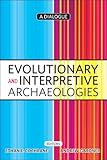 Evolutionary and Interpretive Archaeologies: A Dialogue" (December 1, 2010, Left Coast Press). From what I remember, this book started as a colloquium series while Ethan was teaching at UCL. Given the radically (and explicit) different epistemologies (falsification vs. plausibility as a means of evaluation), I am not sure what the common ground for this dialogue will be (i.e., is it just claiming that plausibility is "good enough"?). If the book serves to demonstrate the critical differences between these kinds of explanatory products, it will be of use. I look forward to reading it.
Wednesday, September 29, 2010
Posing Questions for a Scientific Archaeology
A long time ago, in a galaxy far, far away (well, it was Seattle) there were a group of students in an archaeology graduate program (at the University of Washington) who shared a particular kind of training offered by a curmudgeonly but deeply logical professor (Robert C. Dunnell). These students all spent significant amounts of time preparing proposals for conducting their doctoral research. The challenge they faced was dictated by their advisors: conduct archaeological research that will generate falsifiable answers to questions about the archaeological record. This task is harder than it seems since the first task, asking appropriate questions, has been a quagmire for archaeologists since the origins of the discipline. Yet, to finish their PhDs in this particular program, these students naively took on this challenge and spent years (in many cases) developing their proposals.
In the end, most of the students finished their PhDs by conducting the research that was proposed. The resulting tomes can be found in the UMI repository and in some cases as published volumes. One of the important contribution of their work, however, isn't entirely in the end product. In the end, the results of the research are all determined by the questions being asked and the proposals generated dictating the research design. These documents rarely see the light of day in a publication sense yet are the fundamental basis upon which data are generated and conclusions drawn. Indeed, not all of the students completed their research (largely due to the difficulties involved in actually making the required measurements) but even so, the proposals for the work stand alone as significant accomplishments. In science, asking the right questions is the 99% of the problem.
With Terry Hunt (University of Hawai'i) and Sarah Sterling (Portland State University), I put together an edited volume of these proposal. This book was published back in 2001 by Bergin and Garvey. You can still buy it new off of Amazon.com (http://www.amazon.com/Posing-Questions-Scientific-Archaeology-Millennium/dp/0897897536) for an absurd amount of money ($119) or you can get it used for as little as $10.00. You can even preview the book at books.google.com
The table of contents of Posing Questions.:
Preface
Chapter 1: Posing Questions for a Scientific Archaeology - Terry L. Hunt, Carl P. Lipo and Sarah L. Sterling
Chapter 2: Groundstone Wedge Tool Form and Function: Experimental Analyses in Northern South American “Axes” - Kimberly D. Kornbacher
Chapter 3: The Engineering and Evolution of Hawaiian Fishooks - Michael T. Pfeffer
Chapter 4: Projectile Point Variation in Evolutionary Perspective: An Example from the Central Mississippi River Valley - Kris H. Wilhelmsen
Chapter 5: Social Complexity in Ancient Egypt: Functional Differentiation Reflected in the Distribution of Standardized Ceramics - Sarah L. Sterling
Chapter 6: Community Structures in Late Mississippian Populations of the Central Mississippi Valley - Carl P. Lipo
Chapter 7: Dietary Variation and Village Settlement in the Ohio Valley, A.D. 400 - 1650 - Diana M. Greenlee
Chapter 8: Resource Intensification and Late Holocene Human Impacts on Pacific Coast Bird Populations: Evidence from the Emeryville Shellmound Avifauna - Jack Broughton
Chapter 9: Evolutionary Bet-Hedging and the Hopewell Cultural Climax - Mark E. Madsen
Index
Contributors
Given that Terry Hunt, Sarah Sterling and I hold the copyright, I'm going to link a PDF of this volume. I am releasing this under a Creatives Commons Licence. You can download the book here (about 17 megs).
This work is licensed under a Creative Commons Attribution-NonCommercial-ShareAlike 3.0 Unported License
Subscribe to:
Posts (Atom)