Showing posts with label CSULB. Show all posts

Monday, May 4, 2015

News


Big changes and big news! Starting in the Fall of 2015, I will begin as Director of the Environmental Studies Program at Binghamton University. My ‘home’ department will be Anthropology - a large active department with lots of great people doing fantastic research. In addition to the incredible EnvStudies program, I am particularly excited about the chance to work with PhD students  and the opportunity to work with David Sloan Wilson and his fantastic Evolutionary Studies Program

We will be moving over the course of the summer. Good bye California beach and sun. Hello, woods of the Northeast!

Wednesday, July 10, 2013

Project ideas

From this summer, I've put together a list of possible projects that could be tackled by ambitious (and relatively tech savvy) students for an MA or honor thesis. 

  • Mapping and integrating vertical imaging of surfaces with horizontal imaging (I.e., "greg's" project). This is largely a matter of figuring out how to best integrate the different datasets. Greg focused on the "images" and found they couldn't be matched — which isn't a surprise given the way each program deals with them. But the data are different — the XYZ coordinates. Those should be integrate-able. The images are a separate matter.
  • Detecting and mapping cave features with TIR, NIR and VIS imagery. Jeanette didn't integrate the multiple sources of imagery into a single classification so couldn't get a good product. Im not sure why she didn’t do that other than "not enough time." But this would be the way to go.
  • Multispectral camera (V1.0) use in mapping vegetation. This would be a project that would have a student work on the existing MS camera to map vegetation in an area of interest (e.g., Palo Verde or somewhere else). The current camera is functional and Im working on it to reduce the weight. This way it could be flown with the quadcopters — which means that students can do their own data collect. They would need to be wiling to:  learn some python to process the data, learn to futz with the electronics, have an area interest. But it would be a good project that builds on what we have already and the work that the Montana State University folks did (as ours is a variant of their camera but with more bands). 
  • Multispectral camera (V2.0) The next version of the MS camera is going to be Raspberry Pi based. It will build on the concepts of V1 but have a lot more onboard processing and much higher resolution (and be lighter). What I envision is a camera that has 1 Rpi for each band with a single Rpi acting as controller and data integrator.  The cameras will be the tiny 5.0 megapixel cameras. This would be a great MA project I think. The goal will be to improve on the original  design and make it more modular with better on-board processing (such as automatically producing NDVIs). The student would need to learn python, GDAL, linux and be willing to learn about how the electronics work (but its all fairly simple). 
  • Thermal camera image integration with UAVs — We need someone to take on figuring out how to take thermal imagery with the camera and integrate this into a geospatially referenced mosaic. The project would be electronic, programming, UAVs, and could focus on studying groundwater discharge along the coast of PV (or some other handy area). 
  • Thermal camera mapping of archaeological features. Measuring differences in temperature due to buried rock features has been shown to be a great way to detect archaeology. No one has done this with a platform as small and mobile as what we have. Someone needs to figure out the best procedure for doing this, design a good test study, map some existing features (could do this in Mississippi, rapa nui, guatemala). 
  • Thermal camera detection of artifact composition – Paul Buck (DRI) has demonstrated that long wave sensing can be useful for doing sub pixel mapping of varying density of artifacts. Id like to see if we can use this approach in a micro artifact identification capacity. This would combine image processing (perhaps via ImageJ) and image classification (perhaps via eCognition) to count artifact classes automatically. We would use the thermal camera in a microscope arrangement… 
  • Temper identification in prehistoric ceramics: similar to above but examining how TIR can be used to quantify the composition of ceramics from image analysis alone. 
  • Image analysis for mapping surface archaeological features with X100 We would fly X100 over landscape to map the surface in terms of topography, archaeology, hydrology. We need someone to work on extracting archaeological distributions from the imagery (would need to figure out best sets of filters/wavelengths, techniques in eCognition and so on).
  • Constructing the ideal app for doing aerial photograph connected with photoscan. Someone needs to figure out the timing, georeferencing and processing. This could be a commercial application if done well. The person would need to be willing to learn some programming (well, quite a bit of programming).

Monday, May 9, 2011

Full Professor

Professors

I am happy to report that the Dean of the College of Liberal Arts and the Department of Anthropology RTP committee has recommended me for promotion to full Professor.  Though there were some vile shenanigans at the level of the college committee (and one Department member who was on this committee) but the Dean and Department have strongly supported my promotion.  The final, final word, of course, comes from the Provost who makes the actual decision (this won't be done until June 15).

So with any luck I will soon be wearing, on a daily basis, elaborate robes such as those that Cambridge professors sported in the early 19th century.


Wednesday, March 23, 2011

CSULB at SAA 2011

Despite the continuing politics of power here at The Beach, we have a fairly decent showing at this year's SAA meetings in terms of papers and posters. CSULB students are shown bold text.

Carl Lipo, Hector Neff and Jacob Kovalchik—The Promise and Practicalities of
Rehydroxylation Dating for Prehistoric Ceramic
Anne Breister and Carl Lipo—Technological Changes in Brownware from Owens
and Death Valleys
Judy Bernal, Gregory Holk, Carl Lipo and Hector Neff—An Experimental Study of
Mineralogical Changes and Hydrogen Isotope Fractionation in Ceramic
Pyrotechnology
Carla Pereira—Transmission Patterns among Late Prehistoric Potters of
Mississippi River Valley Ceramic
Paul Burger—Landscape Models for Early Human Occupation in Offshore
Contexts of Southern California
Scott Bigney, Janine Gasco and Hector Neff—Characterization of Obsidian from
Five Late Postclassic sites in the Soconusco Region of Chiapas, Mexico
Scott Van Keuren, Mark Agostini and Hector Neff—Ceramic Pigments and
Communities of Practice in Fourteenth-century Arizona
Federico Paredes, Margarita Cossich and Hector Neff—Drinking Chilate By The
Tomb? A Public Funeral Covered With Ilopango (Tbj) Ash In Western El
Salvado
Hector Neff and Barbara Voorhies—Elemental analysis of the Tlacuachero floors
Dean Arnold, Bruce Bohor, Hector Neff, Gary Feinman and Ryan Williams—
Indigenous Knowledge and the Sources of Palygorskite used in Maya Blue
Fumie Iizuka, Hector Neff and Richard Cooke—Deducing Human Mobility by
Studying the Circulation of Panama’s Earliest Pottery (Monagrillo) (ca. 4,800-
3,200 B.P.
Alex Morrison, Chris Lee, Carl Lipo and Terry Hunt—[Multi-stage Remote Sensing
Applications for Mapping Archaeological Features and Landscape Characteristics:
A Case Study from Rapa Nui, Chile]
Sachiko Sakai—Applications of Optically Stimulated Luminescence (OSL) Dating
in the Study of Change in Clay Source of Olivine-tempered Ceramics in the
Arizona Strip and Adjacent Areas in the American Southwest

Sunday, March 21, 2010

Archaeology at CSULB

Proceedings are on-going for the admission of archaeology graduate students at CSULB for the fall 2010. Stay tuned.

Wednesday, December 2, 2009

Research grants awarded to anthropology professors

http://www.daily49er.com/news/research-grants-awarded-to-anthropology-professors-1.2108532

CSULB is also considering eliminating 16 anthropology courses.

By Trishian Bucheli

Staff Writer

Published: Tuesday, December 1, 2009

Although Hector Neff and Carl Lipo, two Cal State Long Beach anthropology professors, were recently awarded grants to further their research, a large number of anthropology classes are on the chopping block.

Neff, the principal investigator for the Institute for Integrated Research in Materials, Environments and Society at CSULB was awarded $295,226 from the National Science Foundation. Lipo will soon be awarded $310,000. Both grants will be in effect until 2012.

“Getting two grants in a row — it is pretty incredible,” Neff said.

Both professors had to write proposals to NSF and compete against other institutions and schools, such as Stanford University and California Institution of Technology.

“We are doing what we are supposed to be doing; we are bringing the funding and providing research possibilities to students,” Neff said.

IIRMES will be using some of the money to purchase new research equipment such as a laser fluorination system, which will be used to do research on rocks and bricks in order to get the mineral information.

“It will also provide enough money to pay for the expertise to keep the lab running,” said Gregory Holk, a geology associate professor at CSULB and IIRMES co-principal investigator.

Courses proposed to be dropped
  • 453/553: Archaeological Field Research Design
  • 472/572: Archaeology of the Desert West
  • 481/581: Faunal Analysis
  • 485/585: Physical Science Techniques in Archaeology
  • 464/564: Quantitative Methods in Anthropological Research
  • 488/588: Advanced Methods in Near Surface Remote Sensing
  • 551: Artifact Analysis
  • 571: Prehistory of Eastern North America
  • 573: Archaeology of California
  • 587: Cultural Resource Management

The IIRMES lab is used in collaboration by biology, anthropology and geology departments at CSULB.

“Grants allow support — anything that benefits the lab benefits the whole,” said Hayley Zemel, a biology graduate student.

Holk said the instrumentation about the research and lab work is utilized for archaeology findings. According to Holk, there is about $5.5 million in instruments at IIRMES. With the use of a scanning electron microscope, the research facility is able to view small images by using high magnification.

Holk is focusing on light isotope work at IIRMES. The research makes it possible to study the diets of ancient civilizations.

Holk said that by removing the plaque build-up from discovered skeletons, they can look at what the people ate. Each food has a different isotope level of carbon and by studying it, they are able to tell what the ancients ate, such as if it was grain or corn.

The lab has one of two time-of-flight mass spectrometers, which is sought by many researchers. The machine can tell the concentration of an element from archaeological findings such as pottery, Holk said.

“It is important to know the chemical composition of the pottery; it is their form of fingerprints,” Holk said.

However, many undergraduate and graduate students from the anthropology department at CSULB will not be able to work at the research facility.

“Last year, 16 classes were eliminated from the anthropology curriculum,” Neff said. “These classes were the ones that would educate and prepare students in order to work in the lab and prepare them to utilize the equipment, and for future employment.”

The classes were taken off the schedule but may still be offered in future semesters. The College of Liberal Arts and Academic Senate, however, may later decide to eliminate the courses entirely, according to Lipo.

“We are being restricted on the students we can teach,” Lipo said.

Neff said the instructors are told they cannot teach students certain subjects, which they need to learn for future employment.

“The main issues are people’s perception of the sciences. How do we co-habitat — there are many branches of study in the archaeology department,” Lipo said.

There are a lot of difficulties because the work Lipo and Neff are doing are based in science, while those in the liberal arts have a different perspective, Holk said.

Holk said this is the best place for master’s students to go, and that the department has as many instruments as well-funded research labs.

Many master’s students from CSULB are losing out on this opportunity, he said.

Neff mentioned that he has had to get students from other universities to work at IIRMES, such as Cal States Dominguez Hills and Fullerton.

“When the committee decided to eliminate the 16 classes they did not even know what they were eliminating — they only had class numbers in front of them,” Neff said.

Every January, Neff usually takes a group of graduate students to Guatemala to do field research. This coming January, he will not be able to go on the trip.

Neff said, “There are not enough students who know how to use the equipment properly, I need at least some students who know what they are doing.”

Monday, November 16, 2009

Laboratory Safety

I take laboratory safety quite seriously. With chemicals like HF and HCl being used in a low light environment that borders on no light, you really can't be too careful. So I ask all my students to watch this video:

http://www.youtube.com/watch?v=WZ-1lfammjk&feature=player_embedded

And you should too.

Saturday, November 14, 2009

Some strong words about "Leadership"

Blogger "Dr. Crazy" over at Reassigned Time has posted some strong and insightful words about what it means to be a leader in an academic setting. Dr. Crazy is an assistant professor at a midwest university who speaks rather bluntly, though anonymously, about his experience in the academy. In this entry, DC comments on the lack of leadership among administrators - and could easily be speaking about CSULB.

If faculty governance and faculty contribution to a university community is going to work properly, it won't just do so by magic. Because here's the thing: groups of people can only come together to work effectively if they have structure, guidance, and information. There needs to be a person who takes responsibility for creating structure, for guiding decision-making processes, and for disseminating information in a way that is responsible, transparent, and coherent.

In other words, we need administrators. Faculty can't do their jobs unless they have effective administrators to create an environment in which that can happen. Left to their own devices, to piece together information by happenstance and to have discussions and to make decisions without a clear structure, clear goals, and clear guidelines, faculty will most of the time fail. That's right. I said that. Faculty can't just run the university by committee.

Now, faculty members are smart folks. They can do a lot of things well. They can achieve a great deal for a university - above and beyond their individual teaching and research - with strong leadership. With charismatic and strong leadership, they may even be able to achieve this great deal and feel proud of it and like what they're achieving.

But also, faculty members are smart folks. They know when they're being given the run-around. They know when the rhetoric doesn't match the substance. They know when the hundreds of hours they've put into something to make it great have meant nothing, and when that something is being gutted. And once they know these things, they are going to stop being so interested in cheer-leading, in taking one for the team, in doing their jobs well. This is not because faculty members are selfish or scattered or lacking in commitment. It's because they are smart folks, and they know that to be smart means not investing one's time in something that has clearly become totally fucked. They know that being smart means not letting themselves get fucked.

Strong leadership means:
  • Knowing how to run a meeting. If you're sitting at the head of a table, and if you're putting yourself in a position of authority over a group, you also hold responsibility for keeping the group on track. You hold responsibility for focusing the discussion, and for explaining why the discussion is being focused in the way that you choose. You hold responsibility for stopping people from talking over one another, and you hold responsibility for managing the personalities and interests around the table in order to keep the conversation civil and productive. (This is not unlike managing a classroom well, incidentally.) If a meeting is going on for 2 hours and there's no end in sight and people start leaving before it's over? You don't know how to run a meeting.
  • Answering questions honestly, even when the honest answer may not be to everyone's liking. Spin is not strong leadership, particularly when you're expecting a group of people to do the motherfucking dirty work for you.
  • Taking ownership over your role in a particular process. If the travesty that is driving the process is your idea, at the very least you can admit that it was all your idea and explain why. Speaking in the passive voice "it was decided..." "people have agreed..." "it is the case that..." is disingenuous at best. Dude, if you're behind the steering wheel, admit it. Be responsible for it. Take the punches that you fucking deserve for it. You can't keep your hands clean and be a strong leader.
  • Understanding that you don't get to decide things in a vacuum only to force faculty to come together under false pretenses to ratify your decisions.
  • Asking for input before decisions are made, not after. (I suppose that's the same thing as the last bullet, only stated differently.)
  • Realizing that getting people to buy into a process isn't a matter of making decrees or coercing people through scare-tactics (ahem, did we learn NOTHING from the Bush presidency?), but rather about persuading them that their investment in the process actually means something and that it will have tangible, and hopefully positive, results.
  • Making friends with people who have big mouths and getting them to use their big mouths to support you rather than to fight you. And if you try to persuade them and they aren't buying it? Maybe you need to listen to their objections and really take them to heart. And maybe even try to address them directly, rather than just responding with fucking sound bites.
  • Inspiring trust in those whom one expects to do the heavy lifting.
You know why tenure matters? Above and beyond academic freedom in scholarship and in the classroom? It matters because when we don't have strong administrative leadership, and I suspect this happens at all institutions in a variety of contexts at one time or another, somebody needs to be able to speak up, loudly and clearly, on behalf of students, on behalf of faculty, and on behalf of the future of the institution. Tenure has made little difference to me in terms of my scholarship or my teaching. I have never felt in jeopardy in those areas, and I think my institution values my autonomy in those areas. Where tenure has meant the most to me is that I don't have to hold back at all when it comes to fighting bullshit that will hurt my university, my colleagues, or my students. Now, my loud and contentious voice may not make any difference. But at the very least I do have the power to say my piece without fear of losing my job. And since I'm being put in a position where I'm being expected to "participate in" (read: authorize) things that entirely contravene our mission and our values, then I need that power and I need to use it.

But you know what I want? I want a leader. I want a person who will make it unnecessary for me to feel enraged and to go into battle mode. This is not to say that I want a leader who agrees with me in all things or who serves my interests above all others. No, that wouldn't be a good, strong leader. I want a leadership that has a vision, that articulates it clearly, and that doesn't try to pass things through under the radar. I want to be able to be a team player, even if I don't entirely agree, because I trust the ones leading me. I want to feel secure in my leadership's intentions, and I want to be reassured that I don't need to raise hell if I disagree with something because even if I express an objection quietly and civilly that it will be taken into account. I want to be confident in my leadership, knowing that it is making decisions with students, the faculty, and the institution as its first and most important priority. I want leadership that does not betray me, that does not use my hard work to advance a policy or program change only, in the implementation phase of that change after it has been approved, to strip that change of any value or meaning. I don't want to feel as if my leadership is taking advantage of my initiative, abilities, charisma, and intelligence. I want to feel as if my leadership values those qualities in me, respects them, and uses them to initiate positive change.

Look, I believe in compromise. I believe that it's impossible to make all people happy all of the time, and I believe that it's not my leadership's job to make me happy. But I also believe that if you expect people to serve, if you request their service, that you should value that service when it is given. And you should honor the spirit of the final product that those people produce.

I've had two experiences with leadership this week. One of those experiences was exemplary, in terms of demonstrating exactly the qualities that a strong leader has. The other, not so much. Tragically, the lack of leadership that I experienced this week is going to affect every single student at my university, and just about every single colleague of mine within my college.

I am angry, I am demoralized, and I am in no way going to shut the fuck up about the latter of the two experiences. Maybe my angry outcry will make no difference. Probably it won't. But I want it made very clear that I do not endorse what is happening, especially since when everybody was busy trying to get the thing support in the first place, I was the motherfucking spokesmodel.

Lesson learned. [From Leadership]

Thursday, November 5, 2009

CSULB MA Graduate Program in Archaeology - Admissions for Fall 2010

Although the Department of Anthropology is not going out of its way to advertise this, we are officially accepting applications for students who want to get an MA in Anthropology and focus in Archaeology. Yes, you heard it right: we are looking for students and are excited to accept a new group of MA students for Fall 2010.

We are particularly looking for students who are fairly committed to taking a science-based approach to the archaeological record. While there is lots to learn (and brain reorganization required), the result provides students with strong analytic and critical tools necessary to be competitive in archaeology and other related disciplines.

At CSULB, it our goal to provide archaeology students with:

  • strong theoretical training;
  • access and hands-on training on state of the art instrumentation;
  • field work opportunities;
  • exposure to an innovative and highly interdisciplinary environment that combines theory and the use of analytical techniques to solve problems central to the understanding of the physical, life and social sciences;
  • internships and graduate assistantships;
  • funds for student research projects;
  • One-on-one mentorship for graduate work and post-MA careers.

Campus and department applications can be found here: http://www.csulb.edu/colleges/cla/departments/anthropology/ Be certain to email me (clipo@csulb.edu) or Hector Neff (hneff@csulb.edu) if you are interested in the program or are planning to apply. We would be happy to provide you more information and to answer any questions you might have.


Thursday, October 29, 2009

Mapping Anthropology Departments and Citation Analyses

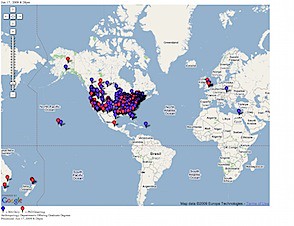
As a lark, last spring I created an interactive map of all of the anthropology departments in the world. This map makes use of Google Maps and their API. You can view the AnthroMap here:   http://mendel.cla.csulb.edu/anthromap/ The main page looks something like this.

There are two kinds of departments shown: Departments with PhD programs (Red) and those with just M.A. Programs (blue). Click on an icon will show you the Department URL, the University URL, and a list of faculty who teach in that Department (accurate up to June 2009). When possible it lists the email addresses of each of the faculty. 200910291825.jpg   

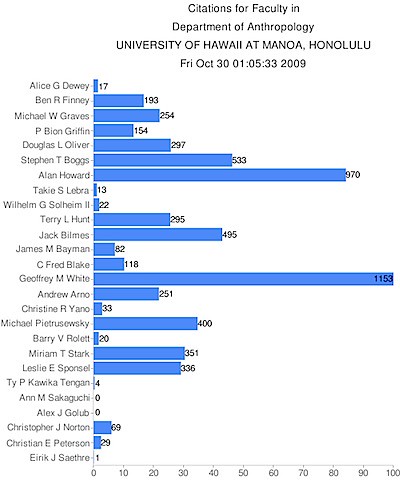
You can also do a citation analysis for the departments. On the pop up window, you can click on "Citation Analyses." This runs a query through Google Scholar for each of the faculty and sums up the number of citations for each published article for which the individual was an author. The data are displayed in bar chart form to allow comparisons. The window also has a list of each of the faculty that links to the articles and the raw citation data.

Note that you might get a baffling HTTP Error 503. As far as I can tell, there are some limits placed on the application as to how often it can query Google Scholar. I suppose I could make this a 'canned search' running every day, but it would take more coding and I'm lazy. If you get this error and know how to fix it, let me know. If not, wait a while and try again. Someday I'll figure it out.

For an example, here is a graph of the citations for the Department of Anthropology at the University of Hawai'i, Manoa.   

200910291823.jpg

If you are looking for references to CSULB's department (and you know who you are... Nancy) you can try this link or possibly this one. Draw your own conclusions about impact to the discipline, productivity and contributions to the University.

Wednesday, October 7, 2009

2009 IIRMES Annual Report

IIRMES is an interdisciplinary institute on CSULB that combines researchers from anthropology, biology, geography, geology, chemistry, physics - and probably a couple of other disciplines. It is housed in a facility in Microbiology and consists of laboratories with shared instrumentation. Our archaeometry and luminescence dating facilities are located within IIRMES. On a yearly basis, we are required to issue an annual report that covers the activities of IIRMES for the benefit of faculty, students, staff and administration. For those of you interested in the following enduring mysteries(**):


(1) what is purpose of life?(2) what is IIRMES and why does it do?(3) can an IIRMES make me more successful and persuasive?(4) if IIRMES were an animal, what animal would it be?(5) what goes on in that mysterious building on the east edge of campus?(6) what have archaeology students been up to?(7) what do archaeology faculty do in their labs?
you might check out the 2009 IIRMES Annual Report that is now online at:
IIRMES2009AnnualReport.pdf  <http://www.iirmes.org/Home/publications/IIRMES2009AnnualReport.pdf?attredirects=0>
**Results may vary. Answers to above stated questions are not guaranteed or even necessarily possible. See your doctor before applying IIRMES to any part of your body. Never drive under the influence of IIRMES. Individuals who are allergic to science are asked to seek professional help. Keep arms and legs inside the moving car at all time. Never point a laser straight at your eye. Avoid sunlight if a vampire. Keep out of sight of zombies.


Friday, October 2, 2009

Enhancing archaeological training with iTunes U.

As many know, the Forces of Evil (tm) have been tirelessly working to prohibit us from teaching students the skills necessary to be functional and successful archaeologists. Buoyed by a sense of righteous power derived from absolutist versions of relativism (where relativism is enforced by law) coupled with vast indifference to outcomes, our collevileagues (tm) continue to figure out ways to keep education as bland and pointless as possible. Fortunately, students now have the Internet from which to draw knowledge to complement whatever bits of training we can slip past the department's curricular guardians. In particular, iTunes U features a wide host of opportunities for learning in nearly all conceivable disciplines. Many of these turn out to be ideally suited for the ambitious archaeology student. So for anyone interested, you might consider enhancing your training in archaeology by taking some free online classes. Below are just some of the classes that are available at iTunes U that will provide you some training in archaeology and related disciplines that will make you smarter, stronger, and better looking (okay... probably only the first).

Introduction to GeoScience: Oxford University

Soil Studies: Open University

Soil and Weathering: Colorado School of Mines

Archaeology: Open University

World Archaeology: Open University

UCLA Series on Evolution, Culture and Human Behavior

If you know any other good iTunes U lectures, let me know!

Sunday, June 7, 2009

Faculty governance ( or the lack thereof...)

An open letter to the Chair of the CLA Faculty Council and the President of the Academic Senate at CSULB.

May 26, 2009

To:                 Nele Hempel-Lamer, Chair, CLA Faculty Council

                       Praveen Soni, Chair, Academic Senate

Cc:                  Gerry Riposa, Dean of Liberal Arts

                        Brett Mizelle, Chair, EPCC Committee

From:             Chrys Rodrigue, Professor, Geography

   Chris Lee, Professor, Geography

    Carl P. Lipo, Associate Professor, Anthropology

                        Hector Neff, Professor, Anthropology

RE:                  Faculty Governance Concerns – EPCC Committee Meeting 19 May 2009

Over the course of the spring 2009 semester a number of Anthropology faculty have organized to remove 16 archaeology-specific Anthropology classes from the archaeology curriculum from the Department. This motion represents a significant programmatic change in the focus and direction of the Anthropology BA/MA degrees, though it was represented as just the minor deletion of a few courses.

On May 19, 2009, the proposal to eliminate all of these courses went to the College EPCC committee and was ultimately "approved". This resolution aside, a number of things took place during the meeting that we find disconcerting with respect to faculty governance and the process by which proposals are evaluated by committees elected by the faculty. Specifically, the faculty governance issues involve the unconventional role of Associate Dean Mark Wiley in the EPCC process and whether his intimidating presence and actions prevented open deliberations and discussions and, therefore, due process for the EPCC to make an informed decision regarding this case. The following points provide some background to our concerns regarding the process undertaken at the May 19th meeting.

(1)   Associate Dean Mark Wiley, an ex-officio member, asked to have people removed due to "Fire Marshal" rules. The EPCC meeting is an open meeting and, as such, all interested parties are allowed to attend and participate. Technically speaking, if the number of people in the room surpassed the 15-person seating capacity that the Fire Marshal allows, this should have triggered (a) finding a bigger room or (b) finding another time when everyone could participate. In this sense, Associate Dean Wiley acted to limit the information available to the committee about the nature and impact of the proposal. Ironically, even with the eviction of the students, the room still contained more than 15 faculty, Fire Marshal standards notwithstanding.

(2)   Associate Dean Wiley's action removed individuals from the meeting who had no other means of participating in this process of major curriculum change. In Anthropology, lecturers and students are not allowed to attend any meeting (committee or department) and are kept uninformed about proposals that directly impact them. The EPCC meeting is the ONLY place in which they have any voice. Yet, they were prohibited from expressing their voice.

(3)   Associate Dean Wiley abused his administrative authority at the meeting, acting at times as de facto Chair and leader of the committee. However, his membership is ex-officio; Dr. Brett Mizelle is the EPCC Chair. The CLA constitution states that, for the EPCC Committee, “The Dean or Dean's designee shall be an ex officio, non-voting member of the Committee. Fundamentally, Associate Dean Mark Wiley, an ex-officio member of the committee, misused his authority as Associate Dean to restrain the process of evaluation and discussion.

(4)   The EPCC is a body elected by College Faculty for the purpose of evaluating the potential impact that proposed curriculum changes have on the College as a whole and its mission. By removing interested parties from this meeting, Dean Wiley acted to undermine the democratic basis of the faculty governance process. The practice and the procedures of the committee are neither determined nor decided upon by Associate Dean Wiley. The CLA Constitution (http://www.csulb.edu/colleges/cla/people/constitution.html) states that “The Committee shall act for the College Faculty, in accordance with Policies and Procedures set by the Faculty Council and the University Academic Senate, in all matters involving curriculum and educational programs.”

(5) The disingenuous use of the Course Change proposal mechanism to effect major programmatic restructuring like this should have resulted in the Committee sending the proposal back to the Department with a recommendation that Program Change is the correct procedure, not the Course Change procedure. Had Associate Dean Wiley not intervened improperly to block discussion, the committee could have learned about and considered the magnitude of the course drop proposal and evaluated whether the Course Change procedure was being used to circumvent the fuller discussion required for major programmatic change. Indeed, the Chair of Anthropology testified at the 5/19 meeting that the proposal was, in fact, a program change and not a course change. As such, it should have been evaluated as such a request, a process requiring far greater participation by stakeholders across the campus and involvement by the Faculty Council.

(6) Questions about postponing the vote until adequate information could be obtained were rejected by Associate Dean Wiley (a non-voting ex-officio member, as specified in the CLA Constitution) before they could be evaluated by the Committee. We do not understand his haste: Tabling the vote would not have hurt the proposal, since the same effect could be achieved by the Department simply not running the 16 courses for at least three years. Not tabling the vote did hurt the many stakeholders in the archaeology curriculum (students in archaeology, archaeology faculty, and faculty in other departments and colleges).

(7) It is essential to note that the EPCC committee was not provided with any names or course descriptions for the courses to be eliminated – only course numbers. Additionally, no rationale or justification for the removal of any of them was offered. The Chair of Anthropology failed to provide supporting evidence or a vision of what the degree is supposed to do without the proposed courses. Consequently, there was, effectively, no basis upon which the EPCC committee could have made an informed decision. In this regard, the decision-making process at the May 19th meeting deviated from all other actions on curriculum proposals, in which specific documents and rationale are required and reviewed. The Anthropology course removal proposal was a particularly unusual request for consideration by the EPCC committee in that it represented a major programmatic change in the content and curriculum of the BA/MA in Anthropology.   The primary argument in support of the 16 course drops consisted of statements claiming that these changes were approved by the Department; yet no documents or any supporting evidence for this claim was made. This is contrary to ordinary curriculum changes that require detailed information about the rationale and justification used for proposing curriculum changes, especially those as drastic as these..

(9) The logic of the rationale of the Associate Dean – that majority vote by the Department was the ONLY criterion by which the proposal needed to be evaluated -- undermines the reason for having an EPCC committee in the first place. If the issue of departmental majority was the only criterion that matters in this proposal, then there was nothing anyone could have said at the meeting to lead to a rejection of the proposal. Not only does this eliminate any role in having a college-level hearing, it also contradicts practice for the evaluation of new course proposals. New courses proposed have their Department’s vote of support, thus, given the logic provided by the Associate Dean, there should never be a reason for the EPCC committee to discuss or evaluate the rationale behind any curriculum proposal.

(10) The Associate Dean restrained the democratic process of evaluation and discussion. At one point, he adamantly demanded that Dr. Lipo “stop” his questioning of the motion on the table, claiming that no new information would be contributed. We believe that members of the EPCC who might have questioned the proposal, including assistant and associate faculty subject to RTP, might have been intimidated into silence. Associate Dean Wiley’s actions prevented the committee from taking the time needed to hear questions from interested parties, ask their own questions, request more data, and generally gather the information needed to make an informed decision representative of the interests of all departments in the College. We are especially concerned that, given Associate Dean Wiley’s angry demeanor, assistant and associate professors kept any questions to themselves.

(11) Finally, we note that the mission of the EPCC committee as outlined in the CLA Constitution is to uphold the mission of the College. This mission specifically includes supporting curriculum that provides students training in analytical and scientific reasoning, quantitative methods and participating in active and ongoing scholarship. Given that NO material was provided with the proposal to demonstrate how dropping classes furthered this mission yet ample documentation was provided to the contrary, there is no constitutional basis to support the decision of the EPCC committee.

Please note that the published formal mission of the College (http://www.csulb.edu/colleges/cla/about/mission.html) is stated as “The College of Liberal Arts offers a curriculum centered in the study of individuals, societies, and cultural groups, past and present, and in national, regional and global contexts. Students acquire skills and knowledge in communication, critical thinking, language and literature, analytical and scientific reasoning, quantitative analysis, and philosophical foundations that enable them to enjoy and understand the rich and dynamic cultural heritage of humanity, lead productive and creative lives, be responsible world citizens, and provide leadership in addressing concerns of society.” In addition, “Students gain an understanding of diverse societies and ethnic and gender issues critical to a changing world. The faculty bring current theories and knowledge to the classroom and create opportunities for students to participate in active and ongoing scholarship. The College provides quality undergraduate, graduate and professional programs that meet critical regional needs.”

Direct Relations of Eliminated Curriculum to the Mission of CLA*

·                        Analytic and scientific reasoning: ANTH 551, ANTH 453/553, ANTH 481/581, ANTH 485/585, ANTH 488/588

·                        Quantitative Analysis: ANTH 464/564

·                        Opportunities for active and ongoing scholarship: ANTH 551, ANTH 453/553, ANTH 485/585, ANTH 488/588.

·                        Dynamic cultural heritage of humanity: ANTH 571, ANTH 472/572, ANTH 573

·                        Critical regional needs: ANTH 573, ANTH 587, ANTH 453/553, ANTH 488/588

·                        Current theories and knowledge: All classes.

During the EPCC meeting, no information was provided to the committee about how the existing courses do not meet the mission of CLA nor how the remaining curriculum does a superior job in meeting this mission. Thus, the process that took place in the meeting violated the core mission of our College and prohibited faculty from allowing democratic action from taking its due course.

In summary, the proceedings at the EPCC committee point to a process that no longer represents faculty governance with due process and fair review. Instead, the committee was forced to rubberstamp the Department of Anthropology’s vote to conduct large-scale programmatic change through abuse of a course drop procedure designed for minor catalogue clean-up. This entirely nullifies the purpose of a faculty-representative committee and its role as independent evaluator. This action contradicts the basis of self-governance at CSULB and, as such, requires investigation by the Faculty Council. We note that the CLA Constitution states that the EPCC vote is only a recommendation and not a final decision. As quoted in the CLA constitution “the Educational Policies and Curriculum Committee shall maintain overview of the educational policies of the College in the framework of the mission of the College and shall make recommendations for action to the Faculty Council and Dean.”

We ask that the decision and process be reevaluated in the interest of the University community and to give voice to the many individuals who are impacted by this motion. Under the provisions detailed in the CLA Constitution (http://www.csulb.edu/colleges/cla/people/constitution.html), we ask:

(1)           The Faculty Council Executive Committee request that no action be taken on EPCC decision of 5/19/09 with regards to the Archaeology courses until the Faculty Council has the opportunity to investigate the rationale, process, and procedures used in its evaluation of the Anthropology proposal (as specified in Article III 6.2b, directed in Article III A.5.2 and Article III A.5.3, and allowed in Article II A.4);

(2)           The Faculty Council Executive Committee request that the proposal from Department of Anthropology be returned to the Department for additional evaluation and justification steps consistent with Program Changes (as allowed under Article II B.2 and the second clause in Article II A.7);

(3)           The EPCC decision of 5/19/09 in relation to Anthropology proposal to drop 16 archaeology classes be evaluated by the Faculty Council (when it reconvenes in the Fall) with regards to the capricious limitation of involvement from affected stakeholders (as allowed in Article II A.7, Article II B.2, Article III A.5.2 and Article III A.5.3).

(4)           The EPCC decision of 5/19/09 be evaluated by the Faculty Council in terms of the consistency of evidence necessary for recommending curricular change for adding and dropping courses (as allowed in Article II A.7, Article II B.2, Article III A.5.2 and Article III A.5.3);

(5)           The EPCC decision of 5/19/09 be investigated for its intent as a Program Change rather than a Course Change, thus requiring more extensive justification and involvement of all campus stakeholders (as determined by the second clause in Article II A.7 and allowed under Article II A.7, Article II B.2, Article III A.5.2 and Article III A.5.3 );

(6)           The Faculty Council raise the issue of faculty governance concerning program changes and review of impact to the College and University as specified under Article II A.4 and the second clause of Article II A.7.

(7)           The actions of Associate Dean Wiley on 5/19/09 be reviewed as to his misuse of an administrative position with regards to faculty governance (as specified under Article A.5.3);

(8)           The Faculty Council review the role of the ex-officio member in the discovery and discussion portion of the evaluation process when the potential exists for reducing committee inquiry due to intimidation of members subject to current and future RTP (as specified under Article III A.5.2); and,

(9)           The Faculty Council review the role of the EPCC committee as an independent body of democratically elected faculty representatives from the College upholding the mission of the College of Liberal Arts with respect to its review of all curriculum changes (as specified under Article III A.5.2).

*Appendix: Courses Proposed for Drop by the Department of Anthropology on 5/19

453/553: Archaeological Field Research Design

472/572: Archaeology of the Desert West

481/581: Faunal Analysis

485/585: Physical Science Techniques in Archaeology

464/564: Quantitative Methods in Anthropological Research

551: Artifact Analysis

571: Prehistory of Eastern North America

587: Cultural Resource Management

573: Archaeology of California

488/588: Advanced Methods in Near Surface Remote Sensing

Saturday, May 16, 2009

Archaeology Curriculum: Wherein the "Two Cultures" Are Shown as Real Real Hits the Road Hits the Road

For those interested, there is a boneheaded proposal at the College of Liberal Arts to drop a set of archaeology courses from the Anthropology curriculum. The proposed set of courses to drop include:

ANTH 453, 472, 481, 485, 464, 488, 553, 551, 571, 572, 573, 581, 564, 585, 587, and 588.

Where these numbers are equivalent to:
453/453: Archaeological Field Research Design
472/572: Archaeology of the Desert West
481/581: Archaeology of California
485/585: Physical Science Techniques in Archaeology
464/564: Quantitative Method sin Anthropological Research
488/588: Geoarchaeology
551: Artifact Analysis
571: Prehistory of Eastern North America
587: Cultural Resource Management
588: Advanced Methods in Near Surface Remote Sensing

These classes consist of the majority of all upper division archaeology and all graduate courses. The "majority rule" of the department has approved this motion with no clear rationale other than a eagerness to eliminate science based archaeology from the Anthropology BA and MA.

A hearing at the College Educational Policies and Curriculum committee will be held on May 19 (tuesday) at 3:30 p.m. at in the Macintosh Building Room 315 ( MHB-315 ).
The key folks in this upcoming hearing are:

Dean Gerry Riposa     <griposa@csulb.edu>
EPCC Committee Chair Brett Mizelle <dmizelle@csulb.edu>
President Academic Senate Praveen Soni <psoni@csulb.edu>
President CLA Faculty Council Nele Hempel-Lamer <nhempell@csulb.edu>

If anyone is interested in obtaining more info, let me know.

Friday, May 8, 2009

50 Years of Two Cultures and a Question

As reported in the The Telegraph and other places today, it has been 50 years since C.P. Snow stood up in the Senate House in Cambridge to present a lecture on the divergence of academia between scientists and "literary intellectuals." Much of his argument stemmed from problems he saw in the British educational system which tended to divert the best students towards studies in "classics" while the less equipped were steered towards science. This practice, he argued led to a culture in which the brightest intellectuals were entirely ignorant of the conceptual basis that underlies our ability to manipulate the world in which we live -- i.e., the basis that created the economy in which pursuits such as literary analysis were made possible. In this way, Snow perceived that society was developing "two cultures" - two separate groups of people shared different priorities: science vs. humanities.

As an academic in a university in which departments are divided into two colleges --the College of Liberal Arts and the College of Natural Science -- it is impossible not to see Snow description's realized. We literally have two entirely separate sets of degrees, departments and faculty who do either science or humanities type of teaching and research. For the most part, students are forced to choose degrees that fall almost entirely in one or the other college. Faculty are treated separately too: those in Liberal Arts are expected to make do with enough space for a keyboard and a chair that may be shared with another while in the Natural Sciences it is standard for faculty to have labs, instruments in addition to their own separate office. We are two cultures.

This is a major issue and source of contention, of course. The Liberal Arts faculty want what Natural Science has to offer. They do not, however, require quite the same kinds of resources so the question about equality is complicated.

The real question, however, is much deeper than issues of square footage, lab resources and other trappings. How can one integrate these two cultures in a conceptual way: teaching students and conducting research that cross boundaries and integrates different approaches into a coherent and productive whole? This is a tougher issue that requires individuals to forget petty rivalries and power issues and to honestly evaluate their intellectual products. We have to ask ourselves about the basis that permits one to make claims about the world at the level of the social and economic substructure that allows all non-subsistence based effort possible as well as what conceptual frameworks make even the most basic knowledge possible. We can't pretend to work in a vacuum with necessary attachment to the work of others - that is simply dishonest, disrepectful and contrary to intellectual tradition of acknowledging the sources of information.

In some ways, artists are best equipped to see how the bridge between humanities and science is bridged. While some may attempt to build art via endless trial and error, the most successful artists are deeply aware of the physics and chemistry basis of whatever media they use. Pushing the envelope in the construction of a massive bronze sculpture requires more than just "common sense" - but an understanding of thermodynamics and structural properties. The greater the knowledge about the boundaries of materials, the larger the potential for doing new kinds of things. Art and science often (but not always) function hand in hand. The other way is also true: scientists seek to explain why artistic works have the properties they do -- from the decoding the imposing effect provided by the geometry of the Partheon to explaining particular combinations of color and texture are perceived in different ways through cognition.

In the seemingly never-ending set of issues that plague my particular department, the issue of science and humanities and their relation is never discussed directly. Predominately the issue that has fractured the faculty is one of power and control: who "owns" anthropology and the content of the education the degrees that the department offers. Ownership in this sense provides individuals control: preference in scheduling, acquisition of square footage, interaction with the best students, removal of critics, control of committees, access to financial resources (perceived and otherwise). However, the consequence of these squabbles and power plays is more than just individual faculty rewards: it is a matter of the degree to which we perpetuate the two cultures.

In my own case, the two cultures comes down to "archaeology" vs. "anthropology" (where the latter term is generally asserted as being the "real" anthropology as opposed to whatever form we are characterized as teaching.). Generally, the latter culture is composed of cultural anthropologists in one form or another (other than the medium and subject matter, it is hard to really distinguish linguistic anthropology from visual anthropology from cultural anthropology from applied anthropology).

Oddly, on the "anthropology" side of the house includes our physical anthropologists (one retiring, the other still active to some degree). On the one hand, I believe that these physical anthropology faculty side on the "anthropology" culture due to their particular personalities: i.e., strict adherence to the status quo, antiquated notions of "sociobiology", etc. On the other hand, there is something more disturbing driving their alignment in the anthropology culture: a sense of eliteness provided them by being "real" scientists as their speciality includes somewhat straightforward biology. In this way, they can align them selves in the culture anthropology and yet remain "above" the fray. They can look down at us as the untouchable high priests of science.

What this means, however, is that the real battle lines are being non-explicitly drawn in a different area and its not about science per se. And this is what I really see the issue of CP Snow's Two Culture as being today: the degree to which science can provide explanations about non-biological selves. This issue points to the core of what anthropology is and has been the source of debate since the late 19th century. Squier and Davis (1848) and Squier (1851) were probably the first Americanists to explicitly espouse making anthropology science as a goal. While the introduction of "exact" measurement of field monuments seemed to be enough to qualify a discipline as scientific to Squier and Davis, other contemporary scientists did not share the view and rained criticism on the Smithsonian Institution and its secretary for wasting the first volume of the Smithsonian Contributions to Knowledge on such frivolous stuff as archaeology {vol 1, no. 1, Scientific American}. Although what was and wasn't science could cause debate, early archaeological scholars were unclear on what science meant to them precisely.

A generation later, William Henry Holmes, the real intellectual giant among American archaeologists in the 19th century and well into the 20th, likewise was explicitly driven by a desire to make archaeology scientific. This is particularly striking in view of the fact that Holmes was an artist by training and retained this interest throughout his career, being the director of the National Art Gallery at the time of his retirement. Obviously he viewed Squier and Davis' proclamation of archaeology as science as premature. A different view of what constitutes science seems indicated. Holmes was the first archaeologist of which I am aware to give "science" a specific interpretation; for Holmes, science was distinguished by laws, was nomothetic, a position that has strong advocates in the modern era. In his " Evolution of the Aesthetic " (Holmes 1892:240) Holmes makes this point abundantly clear in even the most humanistic of topics:"The science of the beautiful must deal with the actual phenomena, with facts as hard, with principles as fixed, and laws as inflexible as do the sciences of  biology and physics." And like Squier and Davis he abhorred those who entered archaeology as a way of escaping from the rigors of real science.

Fast forward to 2009 and the issue about science in anthropology (vis a vis archaeology in this particular case) remains. But as archaeologists we are no longer in the driver seat of our own discipline. For reasons I won't go into here (but see Archaeology as a Process), anthropology as the umbrella discipline has become dominated by individuals who don't see science as having much role in explaining our non-biological selves. To make matters worse, archaeologists have put themselves into a subordinate position to the "real" (i.e., non-science based anthropology) in that archaeology is the data-poor step child. We are in a position where we are the ones who lack credentials in anthropology as we do not attend to the issues deemed central.

This situation is certainly played out in my own department: as anthropologists interested in science, we have been characterized as doing "interdisciplinary work" and thus not real anthropologists. This has lead to a whole series of initiatives that are resulting the purging of science based content in the discipline (though not physical anthropology) -- any course that smacks of a science of ourselves. What is left is basic introductory courses that serve basically as "required reading" for students who are allowed to specialize in any area as long as it is not related to the Culture of Science (in both senses).

Here's the rub. Insidiously the debate about Two Cultures ends up being focused on how physicists can get along with literary types. How can a poet, for example, speak to a chemist? Or how does the biology of the eyeball provide links to a historian studying antebellum art? These sorts of things are what commentators usually spend time discussing.
But when one when it comes down to it that is not the problem -- or really a serious issue. The serious issue is where the two areas -- humanities and science-- collide. And this collision, oddly enough, seems to be occurring most actively in anthropology (though echoes can be found in many of the social sciences). Usually, however, this is a covert event -- done under the cover of curriculum committees who lack any training in what is currently being done with evolutionary approaches in the explanation of human behavior and culture. The basis of our curriculum is being driven by the horde of individuals who learned to reject sociobiology based on early works by Chagnon and E.O. Wilson. Or assumes that cranks like Kevin MacDonald represent evolutionary approaches - or still link social darwinism with evolution. Or a hundred other poorly informed assertions. Yet, (and I'll be assertive here) the advances made in explaining our non-biological selves represent some of the most important areas of research that we can possible do: why are we the way we are?
As a result, while the majority of folks who constitute the Anthropology Culture can smugly remark that they "respect science" and understand its role in society, they simultaneously make it nearly impossible to develop a science in the area we need it the most.
And this is where I am. I work in a department that is the poster child of the quiet battle between cultures. Certainly, it is played out through a cast of kooky characters and deep historical rifts that long predate me. The issues, though, are common: what kind of anthropology should be presented in our curriculum and supported in research? what is a four-field anthropology? Should we be training students to be scientists or humanists? If both, then how do we fit this into a finite set of courses with finite resources. What if the material taught in classes is entirely contradictory? If one is science or humanities focused, must one do the other as well or should specialization be allowed?
These central questions, one might think, would be the topic of faculty meetings, curriculum committees and brown bags. But they aren't -- the war is waged by the majority voting any dissension out of existence.
Herein lies my question. I've written a lot of fairly honest stuff about the crazy antics of this department. Truth is a double edged sword, though and it doesn't always pay to be openly and proactively honest. Marketing is what makes many careers. However, the issues are substantial and speak directly to my perception of the value of the job that I do. So, is it worth it to continue these accounts with the idea of revealing the tricks that are played? Or are honest behind-the-scenes blogs like this just politically, socially and economically a bad idea?
I really dunno.