
Showing posts with label evolutionary archaeology. Show all posts
Showing posts with label evolutionary archaeology. Show all posts
Monday, October 26, 2015
Evolutionary Research and Graduate Programs at Binghamton University... Interested?
Now that I have landed at Binghamton University, I am looking forward to working with graduate students who are interested in pursuing a PhD in evolution-based research focusing on the archaeological record and/or historical and contemporary data. Ideal students would have an interest in quantitative methods, programming and other kinds of tools that enable evolutionary modeling (e.g., simulation). Some experience in archaeometry, artifact analysis, phylogenetic analyses, materials analyses, geochronology, GIS, remote sensing, paleoenvironmental analyses, spatial studies, statistics, etc. would be beneficial though training in these areas is certainly available at Binghamton. Fundamentally, I am looking for students who are passionate about science and share my passion for figuring out why the human past unfolded as it did.  Binghamton University offers a remarkable array of resources that can provided a background and training in evolutionary studies. Within the Anthropology Department, the PhD program is a general sort with the usual exposure to anthropological research. However, in my own courses I teach all my classes within a science- and evolutionary based framework. In addition to my own classes, opportunities exist within the department to gain training from other faculty. For example, Koji Lum runs the Laboratory of Evolutionary Anthropology and Health (LEAH) and does research that emphasizes the Pacific islands, a region of particular interest to me. David (Andy) Merriwether runs an ancient DNA laboratory and is doing amazing work studying past populations of camelids. The potential for collaborative work and cross-training in these laboratories is exceptional. In the area of paleoanthropology, Rolf Quam is studying human evolution and has been active at Atapuerca in northern Spain.
Outside the Department there is an even greater array of opportunities for training in evolution. First, we have EVoS, the Evolutionary Studies Program. EVoS is an interdisciplinary program that brings together faculty from across the University who are interested in evolutionary theory and evolutionary science. EVoS offers classes in evolutionary thinking and has a prominent lecture series that brings researchers from around the world to present on evolution-based research. The Director of EVoS is David Sloan Wilson, who is well-known for his evolutionary theory advocacy, research into the dynamics of group-level behavior and applications of evolutionary thinking to contemporary issues in communities. Wilson is a remarkable thinker who is fearless in his approach to using evolution in the study of human populations.
Second, Binghamton has the newly established Center for Collective Dynamics of Complex Systems, CoCo. CoCo is an interdisciplinary program that fosters collaborations among faculty who are interested in studying complexity. Many of the CoCo researchers make use of evolutionary dynamics as a means of studying change in populations and their foci complement that of EVoS quite nicely.
In terms of science-based analyses of the archaeological record and in addition to resources in Geological Sciences, Binghamton has the Advanced Diagnostics Laboratory (ADL). ADL is a centrally managed laboratory with a diverse array of instruments that are suitable for studying physical properties of material culture. These instruments will play an important role in generating data on variability in artifact performance as it varies over space and time.
In the realm of field research, we are currently putting into place a program in remote sensing and geospatial research through a collaboration with Geography, Geology, the MA program in Public Archaeology and Environmental Studies. This collaboration will bring together tools and instruments for mapping landscapes at the surface and subsurface. We are in the process of assembling a suite of fixed wing UAS, rotor UAS - with color, NIR and LiDAR sensors. We are also setting up a laboratory for object-based image analysis and are acquiring a suite of geophysical equipment: ground penetrating radar, seismic, resistivity and magnetometry/gradiometry. We should be well positioned to offer training in cutting edge field techniques in the next year.
Funding is available for graduate students within the Anthropology department. Applications should be submitted early to be considered for departmental funding. Additional sources of funding depend on research projects and funds that are always in the works.
Overall, I welcome students who wish do evolutionary research in any part of the prehistoric, historic and contemporary world. While my own work is in the Pacific and the Mississippi Valley, students need not focus in those areas. If any of this interests you, feel free to contact me. In addition, check out the Anthropology graduate program and application procedures. We'd be happy to give you the tour of the University if you care to visit the beautiful Northeast.
Binghamton University offers a remarkable array of resources that can provided a background and training in evolutionary studies. Within the Anthropology Department, the PhD program is a general sort with the usual exposure to anthropological research. However, in my own courses I teach all my classes within a science- and evolutionary based framework. In addition to my own classes, opportunities exist within the department to gain training from other faculty. For example, Koji Lum runs the Laboratory of Evolutionary Anthropology and Health (LEAH) and does research that emphasizes the Pacific islands, a region of particular interest to me. David (Andy) Merriwether runs an ancient DNA laboratory and is doing amazing work studying past populations of camelids. The potential for collaborative work and cross-training in these laboratories is exceptional. In the area of paleoanthropology, Rolf Quam is studying human evolution and has been active at Atapuerca in northern Spain.
Outside the Department there is an even greater array of opportunities for training in evolution. First, we have EVoS, the Evolutionary Studies Program. EVoS is an interdisciplinary program that brings together faculty from across the University who are interested in evolutionary theory and evolutionary science. EVoS offers classes in evolutionary thinking and has a prominent lecture series that brings researchers from around the world to present on evolution-based research. The Director of EVoS is David Sloan Wilson, who is well-known for his evolutionary theory advocacy, research into the dynamics of group-level behavior and applications of evolutionary thinking to contemporary issues in communities. Wilson is a remarkable thinker who is fearless in his approach to using evolution in the study of human populations.
Second, Binghamton has the newly established Center for Collective Dynamics of Complex Systems, CoCo. CoCo is an interdisciplinary program that fosters collaborations among faculty who are interested in studying complexity. Many of the CoCo researchers make use of evolutionary dynamics as a means of studying change in populations and their foci complement that of EVoS quite nicely.
In terms of science-based analyses of the archaeological record and in addition to resources in Geological Sciences, Binghamton has the Advanced Diagnostics Laboratory (ADL). ADL is a centrally managed laboratory with a diverse array of instruments that are suitable for studying physical properties of material culture. These instruments will play an important role in generating data on variability in artifact performance as it varies over space and time.
In the realm of field research, we are currently putting into place a program in remote sensing and geospatial research through a collaboration with Geography, Geology, the MA program in Public Archaeology and Environmental Studies. This collaboration will bring together tools and instruments for mapping landscapes at the surface and subsurface. We are in the process of assembling a suite of fixed wing UAS, rotor UAS - with color, NIR and LiDAR sensors. We are also setting up a laboratory for object-based image analysis and are acquiring a suite of geophysical equipment: ground penetrating radar, seismic, resistivity and magnetometry/gradiometry. We should be well positioned to offer training in cutting edge field techniques in the next year.
Funding is available for graduate students within the Anthropology department. Applications should be submitted early to be considered for departmental funding. Additional sources of funding depend on research projects and funds that are always in the works.
Overall, I welcome students who wish do evolutionary research in any part of the prehistoric, historic and contemporary world. While my own work is in the Pacific and the Mississippi Valley, students need not focus in those areas. If any of this interests you, feel free to contact me. In addition, check out the Anthropology graduate program and application procedures. We'd be happy to give you the tour of the University if you care to visit the beautiful Northeast.


Thursday, November 18, 2010
Evolutionary and Interpretive Archaeologies: A Dialogue
While I am not sure what the dialogue is going to consist of, colleague Ethan Cochrane and co-editor Andrew Gardner are on the brink of publishing a new edited volume entitled " 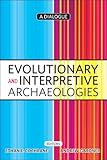 Evolutionary and Interpretive Archaeologies: A Dialogue" (December 1, 2010, Left Coast Press). From what I remember, this book started as a colloquium series while Ethan was teaching at UCL. Given the radically (and explicit) different epistemologies (falsification vs. plausibility as a means of evaluation), I am not sure what the common ground for this dialogue will be (i.e., is it just claiming that plausibility is "good enough"?). If the book serves to demonstrate the critical differences between these kinds of explanatory products, it will be of use. I look forward to reading it.
Monday, November 1, 2010
Philosophical Transactions of the Royal Society B
Ethan just let me know that the special issue of the Philosophical Transactions of the Royal Society B -- edited by James Steele, Peter Jordan and Ethan Cochrane is now available online.
Cultural and linguistic diversity: evolutionary approaches

Recent work has shown that language and other human cultural practices can be considered as evolutionary systems operating on the Darwinian principle of 'descent with modification'. An emerging field of interdisciplinary science builds on phylogenetic and other methods adopted from biology, and adapts them to explain the transmission histories of suites of cultural traits (whether languages, social structures, or artefacts). This theme issue asks what social processes lead to coupled and decoupled transmission of different cultural traits or suites of traits, and how their transmission histories can be estimated retrospectively using quantitative methods. Understanding the factors affecting descent histories is central to explaining how cultural diversity arises and how it is maintained. These questions are of interest and relevance not just to social science and evolutionary theory, but also to planners working on topics such as endangered language maintenance.
Monday, September 28, 2009
Simon Conway Morris - Lecture on Inevitability of Humans
While there are aspects about "inevitability" that are taken too literally (in that history is constrained because it has *already happened*) and that makes me alert for "woo-woo thinking", there is a good iTunes U lecture by Simon Conway Morris on the constrained design space in which evolution can occur. Conway Morris was the paleontologist that worked on the Burgess Shale fossils (originally collected by Charles Walcott in 1909). His findings provided ample fodder for Stephen Jay Gould to argue for the historical contingency of evolution in Wonderful Life. Ironically, in recent years Conway Morris has argued for something akin to the opposite of this stance: the convergence evolution. Here, he argues that that we are not here by chance: but are inevitable due to the strong structuring dimensions of the physical universe. This is explained in detail in his book Life's Solution: Inevitable Humans in a Lonely Universe.
I think the understanding of design constraints is an important issue, especially for archaeological applications of evolution. We need this concept in order to understand the space in which style can occur versus what is technologically necessary. For example, decoration can vary infinitely yet the vessel upon which it is placed may still have to serve as a fireproof container. Holes cut in the sides are part of that particular design space. Thus, we must be careful to construct classifications within those constraints in order to not confuse analogous similarity with homologous similarity. In many cases, the design space may be far smaller than one might think.
Conway Morris goes a little far here by arguing that the design space for life makes humans inevitable. There are certainly some dimensions of humans that are due to design constraints but distinguishing which are due to historical constrains (i.e., the environment of evolution) and which are due to design constraints (i.e., the chemico-physical dimensions that make us possible) are something to analyze, not to assume a priori.
The lecture is, nonetheless, a good one for thinking about evolution and issues of convergence.
Thursday, December 4, 2008
London
Well, I am off to London this afternoon to participate in a workshop on "Cultural and linguistic diversity" at the AHRC Centre for the Evolution of Cultural Diversity.
My paper, coauthored with Mark Madsen is "Networks, frequency seriation and models of cultural transmission." I'll have an online draft of that paper up shortly if anyone is interested. The workshop is a small affair - held outside of London at the Missenden Abbey Conference Centre (www.missendenabbey.co.uk). The place is sort of isolated in a manor type fair with only 16-17 or so participants. The "usual" crowd is there for these kinds of affairs O'Brien, Collard, Cochrane, Tehrani, Peter Jordan Mace - but also Rob Boyd, Russell Gray, Daniel Nettle (who will apparently be a disembodied head in a Skype link [could we all do that? a gathering of monitors?), John Nerbonne, Fiona Jordan, Charles Nunn and some others who I don't know as well.
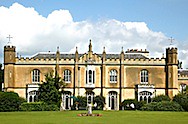 Seems like a good place to hang out in... Ill be online (of course) for much of this trip - return on the 13th.
Workshop Programme – Cultural and linguistic diversity
Wednesday 10th Dec 2008
0845 – 0900 The Organizers Welcome and introduction to the workshop
0900 – 0955 Russell GRAY [Transmission coupling mechanisms: migration/demic expansion]
0955 – 1050 Rob BOYD Transmission coupling mechanisms: cultural group selection (co-authored with Peter Richerson)
1050 - 1115 TEA/COFFEE
1115 – 1210 Daniel NETTLE (by Skype link) Genetic and linguistic diversity: Global distribution and implications for prehistory
1210 – 1305 Paul HEGGARTY Splits or waves? Trees or webs? Network analysis of language change
1400 – 1455 Claire BOWERN Historical linguistics in Australia: (non-) tree-like evolution and its implications
1455 – 1550 John NERBONNE Measuring the diffusion of linguistic change
1620 – 1715 Carl LIPO Networks, frequency seriation and models of cultural transmission (co-authored with Mark Madsen)
1715 – 1810 James STEELE On demographic interpretations of linguistic and cultural phylogenies (co-authored with Anne Kandler and Aimee Plourde)
Thursday 11th Dec 2008
0900 – 0955 Michael O’BRIEN
Material culture and units of transmission (co-authored with R. Lee Lyman, Alex Mesoudi, and Todd L. Van Pool)
0955 – 1050 Mark COLLARD [Cladistic analysis of cultural traits]
1115 – 1210 Charles NUNN
Simulating trait evolution for cross-cultural comparison (co-authored with Christian Arnold, Luke Matthews, and Monique Borgerhoff Mulder)
1210 – 1305 Ruth MACE Is horizontal transmission really a problem for phylogenetic comparative methods? A simulation study using continuous cultural traits (coauthored with Tom Currie and Simon Greenhill)
1400 – 1455 Jamie TEHRANI Mapping traditions onto populations using trees and jungles: a cophylogenetic approach to cultural inheritance (co-authored with Mark Collard)
1455 – 1550 Ethan COCHRANE Phylogenetic and graph-based network methods in evolutionary anthropology (co-authored with Carl Lipo)
1620 – 1715 Laura FORTUNATO /Fiona JORDAN Your place or mine? A phylogenetic comparative analysis of postmarital residence in Indo-European and Austronesian societies
1715 – 1810 Sean O’NEILL /Peter JORDAN Coupling and de-coupling inherited cultural traits: preliminary investigations of situated social learning
processes as an explanation for cultural diversification on the Northwest Pacific Coast
Monday, April 14, 2008
479 Eastern North America - Video Lectures from RCD
This semester, I am teaching the prehistory of Eastern North America. It is a cool class teach for a couple of reasons: (1) the archaeology of the eastern woodlands and surrounding environments is spectacular. (2) teaching about ENA allows me to build on the foundation created by RCD in ARCHY 479.
In light of this, I have put up a couple of videos from 1996 ARCHY 479. You can download these at:
575! Field Research Design! Bonus 497!
I am happy to report that I was finally able to pry enough time through crafty use of procrastination to create and convert all of the Archy 575 Lectures from the University of Washington (all from the Fall of 1995). You can enjoy the wayback goodness at:
http://darwin.anth.csulb.edu/rcd/575/index.htm
Ive also upload new lectures from 497 (Method and Theory 1). These can be found here:
http://darwin.anth.csulb.edu/rcd/497/index.htm
If you enjoy these or make use of them, let me know!
Sunday, February 17, 2008
Human Culture Subject To Natural Selection, Study Shows
The quotes in here suggest that no one has ever demonstrated that cultural variants are shaped by natural selection. Odd, considering that many of the folks I know have been doing just that since the late 1970s. I guess our marketing and press releases weren't up to snuff - or we didn't get the right validators to gush over our work. Nonetheless, it sounds interesting - though it won't be out in PNAS until Feb 19th.
[From Human Culture Subject To Natural Selection, Study Shows]
Monday, January 28, 2008
First Day Back
Back to school, spring semester 2008. The parking lots are full, the sidewalks jammed and the buzz of gossip, stories, and yawns fill the air. I'm teaching the second part of Method and Theory (Explanatory Theory) and Eastern North America Prehistory this semester. The classes are primarily T Th and both are topics close to my heart. I'm looking forward to Eastern NA -- Ive run this as a seminar/lecture before but it was relatively informal. Now its a formal lecture type class and an opportunity to establish evolutionary models regarding human prehistory into people's minds.
In some, this kind approach has become a gamble with numerous comments and remark from my non-archaeological colleagues as to how "disturbed" that evolution is being incorporated into anthropology curriculum. Most of this, of course, is the result of misunderstandings about evolution and its role in the explanation of heritable variability. Its as though the shadow of eugenics haunts the areas in most anthropologists minds when the word "evolution" and "culture" are used in the same sentence (that or the words simply evoke commonsensical change).
Well, on with the semester - time to crank out the syllabus, fire up the Powerpoint and get the handouts rolling out of the printer.
Monday, April 23, 2007
Society for American Archaeology Meetings - Austin, TX 2007
I'm very pleased to note that a number of CSULB graduate students will be presenting at this year's SAA meetings in Austin, TX. This is the "world series" of archaeology meetings and it is quite rewarding to know that our students are up to (and, surpass!) the professional standards of the discipline. Here are the CSULB papers/posters for 2007 (student names in bold):
- Veronica Harper, Hector Neff and Carl Lipo—Basalt Artifact Sourcing on Easter Island
- Kristin Safi, Carl Lipo, Terry Hunt and Sergio Rapu—Geophysical Explorations and Sequences of Monumental Architecture at the Anakena Dune of Easter Island
- Roberta Thomas, Hector Neff and Carl Lipo—The Sourcing of Stemmed Obsidian Bifaces on Easter Island
- Ian Fraser-Shapiro and Will Gilstrap—Obsidian Microdebitage Analysis By LAICP- MS
- John Terrell, Ethan Cochrane and Carl Lipo—Branching vs. Blending is Not the Question
- Jelmer Eerkens and Carl Lipo—Technological Change and Brownware Pottery Technologies in the Western Great Basin of North America
- Matthew Bell, Carl Lipo and Terry Hunt—Aerial Photography of Surface Features on Rapa Nui (Easter Island)
- 8:00 P. Jeffrey Brantingham—Style, Function and Archaeological Site Frmation Processes
- 8:15 Mike Cannon—Modeling the Tradeoff between Foraging and Farming
- 8:30 Todd VanPool—Sex and Labor: An Evolutionary Model of the Division of Labor
- 8:45 Jillian Galle—Conspicuous Consumption and Gendered Social Strategies among Slaves in the 18th Century
- 9:00 Sarah B. McClure and Douglas J. Kennett—Cultural Transmission and the Generation of Variation in Spanish Neolithic Pottery
- 9:15 Jonathan Scholnick—Cultural Transmission and Spatial Patterning in Historic New England Gravestones
- 9:30 Aimee Plourde—Contributions to the Study of Sociopolitical Hierarchy from a Theory of the Evolved Capacity for Prestige
- 9:45 John Darwent—Phylogenies of Thule Period Harpoon Components from the North American Arctic
- 10:00 Karen Y. Smith—Correspondence Analysis: A Method for Monitoring Branching and Convergence in the Archaeological Record
- 10:15 John Terrell, Ethan Cochrane and Carl Lipo—Branching vs. Blending is Not the Question
- 10:30 Jose Luis Lanata and Arleen Garcia -Herbst—Exploring the Tempo and Mode of America’s Human Dispersal
- 10:45 Mark Collard and Briggs Buchanan—A Matrix Correlation Test of Early Paleoindian Migration Route Hypotheses
- 11:00 Briggs Buchanan and Mark Collard—Investigating the Peopling of North America through Cladistic Analyses of Early Paleoindian Projectile Points
- 11:15 Hector Neff—Discussant
Subscribe to:
Posts (Atom)