Thursday, April 9, 2009

Evolutionary Dynamics of Cooperation

On another note, there is a symposium on saturday afternoon entitled "EVOLUTIONARY DYNAMICS OF COOPERATION" that is being organized by David Carballo. While the symposium includes my good friend and colleague Jelmer Eerkens, I have a hard time believing that the papers are really going to represent "evolutionary dynamics" in the sense that the rest of evolutionary biology means the term. I might be pleasantly surprised, but when one sees titles like "Cooperation, Ritual and the Emergence of Classic Maya Rulers" one can typically expect anthropological mumbo-jumbo that has no relationship to evolution (as a theory) and certainly not evolutionary dynamics in any meaningful (i.e., explanatory) sense (ala Nowak and other).

I'll certainly check it out, but my expectations are sadly pretty low.

Other papers not to be missed at the 2009 SAAs

There are a variety of other presentations that I think should be on the lists of "must sees" at this year's SAA meetings.

Long time friend and colleague, Tim Hunt is making his return to archaeological research with his long-in-the-wings study of surface characterization of lithics. Tim is presenting his poster "Fracture Surface Characterization of Heat-Treated Cherts" on Friday Morning. The poster should be presenting data Tim collected using a new profilometer and will include fractal analysis of surface structure. I'm fairly certain this is going to make the crappy junk science that people have done with heat treatment look (as it should) like 8th century AD alchemy (if it bleeds, it's a witch!).

I think the symposium (Thursday afternoon) being put on by Nathan Goodale (now TT at Hamilton College) and Bill Andrefsky (WSU) on "EVOLUTIONARY APPROACHES TO UNDERSTANDING STONE TECHNOLOGIES AS A BYPRODUCT OF HUMAN BEHAVIOR" will be a good one. While I wish this was a poster session and not a series of papers (so 1972), the titles of the papers look interesting and useful. With posters and other things going on, who can really sit for an entire afternoon to listen to all the papers?

1:00 Nathan Stevens—How Should Evolutionary Theory be Incorporated into Lithic Analysis?

1:15 Lee Lyman—Graphing Evolutionary Pattern in Stone Tools to Reveal Evolutionary Process (hmmm. sounds familiar)

1:30 Colin Quinn—Signals in Stone: Exploring the Role of Social Information Exchange, Conspicuous Consumption, and Costly Signaling Theory in Lithic

Analysis

1:45 Robert Bettinger, Christopher Morgan and Loukas Barton—The North China Nanolithic

2:00 Loukas Barton, Christopher Morgan, Robert Bettinger and Dongju Zhang—The Economics of Stasis: Pleistocene-Holocene Quartz Industries on China’s

Western Loess Plateau

2:15 Charlotte Beck and George T. Jones—A Case of Extinction in Intermountain Paleoindian Lithic Technology

2:30 Jennifer Ferris—Central Place Foraging Theory and Toolstone Procurement Costs: Determining Source Distance from Lithic Debitage Reduction Techniques on Espíritu Santo Island, Baja California Sur

2:45 Carl Lipo, Brooke Hundtoft and Terry Hunt—Analyses of Stylistic Variability among Stemmed Obsidian Artifacts on Rapa Nui (Easter Island)

3:00 Marcus Hamilton and Briggs Buchanan—Viewing cultural transmission as a diffusion process: Models, tests and implications

3:15 Nathan Goodale, William Andrefsky, Lara Cueni, Curtis Osterhoudt and Ian

Kuijt—Cultural Transmission and the Production of Material Goods: A Neolithic Case Study of the Neutral Model and Identity in Notched Points

3:30 Lisa Fontes, Nathan Goodale, Anna Prentiss and Curtis Osterhoudt—Tracing a Migration: A Study of Athapaskan Side Notched Points and Evolutionary Patterns

3:45 Anna Prentiss, Curtis Osterhoudt, Nathan Goodale and Nicole Crossland—

Cultural Transmission and the Organization of the Lithic Technology: The Slate Tool Industry from the Bridge River Site, British Columbia

4:00 Todd Van Pool, Michael O'Brien and R. Lee Lyman—Innovation and Natural Selection in Paleoindian Projectile Points

4:15 Michael Shott—Morphometric Approaches to the Study of Fluted Points

4:30 Ken Ames—Discussant

4:45 Jim Boone—Discussant

CSULB at the 2009 SAA Meetings

Despite science-fearing, anti-intellectual, short sighted, uniformed, and fear driven shenanigans, we have a good line up of papers and posters at the 2009 SAA Meetings in Atlanta. It is unclear what is going to happen next year, but we soldier on. Someone has to keep up the good fight.
The 2009 Line Up
On Thursday evening archaeology graduate student James (Jimmy) Daniels has organized a session entitled: "Innovative Analytical Techniques in Coastal Guatemalan Archaeology." Papers include:


** Kristin Safi, Hector Neff, Carl Lipo and Oswaldo Chinchilla—Measuring spatial
organization at El Baul, Cotzumalguapa, Guatemala 

** Tony Quach, John G. Jones and Hector Neff—Paleoenvironmental Investigations of the Tecojate Region of Coastal Guatemala and Implications for the Classic Maya Collapse
** Adrian Abella and Dr. Hector Neff—Innovative Analytical Techniques in Coastal Guatemalan Archaeology
** James Daniels—Using Distributional Archaeology and GIS to Determine Functionality of Subsurface Structures Detected with Geophysics at El Baul
** Brigitte Kovacevich, Rafael Castillo, Molly Morgan and Hector Neff—The Use of Laser Ablation Inductively Coupled Mass Spectrometry (LA-ICP-MS) on Obsidian Microdebitage: Case Studies from Chiquiuitan and El Baúl
** Maureen Lynch—The Effects of Moisture on Ground Penetrating Radar in La Blanca, Guatemala
** Victor Castillo, Hector Neff, Ronald Bishop and M. James Blackman—Mold made figurines from the South Coast of Guatemala: sources of raw material and proveniences
Other CSULB authored papers include:
** Josué Gómez, Douglas J. Kennett, Hector Neff, Michael D. Glascock and Barbara Voorhies—Early Formative Interactions between the Soconusco and the Gulf Coast Olmecs (Friday morning)
** Hector Neff—Twenty Years of Ceramic Provenance Research at MURR (Friday morning)
And Posters:
** Andrea Bardsley and Carl Lipo—Luminescence Dating and the California Desert (Thursday afternoon)
** Carl Lipo, Brooke Hundtoft and Terry Hunt—Analyses of Stylistic Variability among Stemmed Obsidian Artifacts on Rapa Nui (Easter Island) (Thursday afternoon)
** Andrew Page, Carl Lipo and Diana Greenlee—Variability in Thermal and Compositional Properties of Poverty Point Objects (Thursday afternoon)
** Terry Hunt and Carl Lipo—A cultural phylogeny of statues on Rapa Nui (Easter Island) and the implications for prehistoric social organization (Friday afternoon)

Monday, March 30, 2009

Academic Random Copying

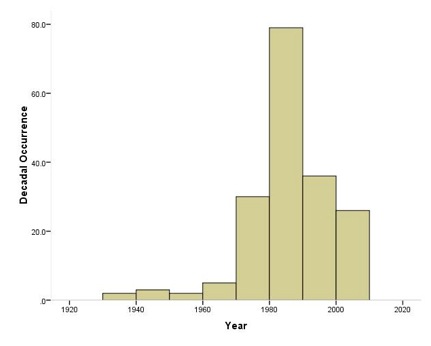
While working on a presentation about cultural transmission, I did some exploration in the archaeological literature about patterns of word usage over time. The patterns are about what one would expect. Here is a graph of the occurrence of "social" and "ecology" by decade in the pages of American Antiquity from 1936 to the present. This is, obviously, telling us something about the nature of discipline. Conclusions are left to the reader.

200903301428.jpg

Sunday, March 29, 2009

WSU and Pullman

I just returned from a trip to Pullman, Washington and WSU. I was there as the 2009 Anthropology Graduate Organization (AGO)'s visiting scholar. It was an honor as it indicated that at least some students have heard of my work and that enough felt it was significant enough bring to campus. I had a delightful time. The students were enthusiastic and interesting. I was shepherded around from meeting to class to meeting to meal to lecture. And I got to talk with a wide variety of folks from the many grad students to the faculty. Pullman is certain "as advertised" in its remote, small town setting but the fact it is so isolated seems to select for folks who are extremely passionate about what they do, and that always translates into a vibrant and exciting community.

My lecture was "Networks, Small Worlds and Cultural Transmission." Given the nature of the invitation, I targeted it at graduate students and probably tried to include far to much about the relations between our models, methods and explanation but it certainly was fun to present for me.

All-in-all it was an excellent visit and I hope to see many of the folks I met there again either here at Long Beach, the SAAs or elsewhere.

Monday, March 23, 2009

Sad and Unexpected News...

I've just learned that Steve McCormick one our long-suffering graduate students passed away late last week due to health problems. Steve was a graduate student when I first arrived at CSULB. He completed his course work and was slowly attending to his MA thesis. He began working for Cogstone, a local CRM firm on a fulltime basis and like many students, the reality of a real paycheck and actually doing archaeology on a professional basis moved his interests away from his degree. As a student, he asked lots of questions and had tremendous enthusiasm for the discipline and its practice. Steve was an extremely friendly and genuinely nice person and was well liked by the faculty and the rest of the students. He spread the reputation of our MA program among contract firms and help get a number of our students jobs at Cogstone. I can definitely say he will be missed. This is very sad news.
Steve McCormick (left) with Dan Larson and Sachiko Sakai in the field (SE Missouri) using the magentometer and GPS.

Steve McCormick (just below the pig and in the red shirt) with students from CSULB, RC. Dunnell, Dan Larson and MIke Cannon.

Monday, March 2, 2009

New Photo Rig

I have been working on a new camera rig for the new 15' blimp (Floatograph) we recently purchased with Geography. Geography also bought a series of new cameras: 2- Canon Powershot (A590 - 8 megapixel and image stablization) and 2 Fujifilm FinePix IS-1. The latter is particularly interesting as it records near-infrared in addition to visible light (wavelengths 400-900 nm). We also got a battery powered video transmitter that can be used to send NTSC video output from a camera to a ground receiver and displayed on a monitor.

Using the Airtronics VG400 for the controller, servos and transmitters, I created new mounts for the cameras. The mounts are simpler than earlier versions as I realized that some of the design considerations that John Dudgeon had used were specifically for flying cameras with (the much more volatile kites). I also was able to place some of the "common" components on the picovet suspension.   

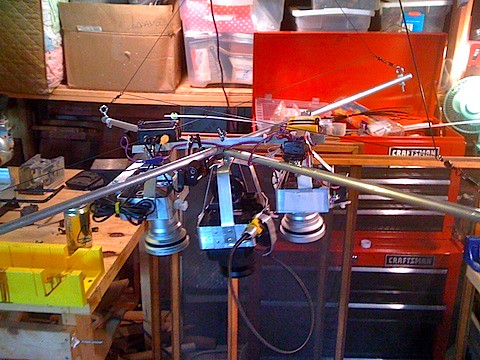
Below is a photo of the rig as I was nearing completion. I added means for tiling the Canon Powershot cameras out to the sides - so that we could get overlapping images and wide coverage. The near-IR camera is in the center. Since it had a cable release socket, I used a cable to trigger the IR shutter combined with the radio controlled servo. I need to beef up the hanging parts of the picovet and replace swivels and whatnot.

I am excited about trying this out.


200903021807.jpg