Monday, September 28, 2009

Simon Conway Morris - Lecture on Inevitability of Humans

While there are aspects about "inevitability" that are taken too literally (in that history is constrained because it has *already happened*) and that makes me alert for "woo-woo thinking", there is a good iTunes U lecture by Simon Conway Morris on the constrained design space in which evolution can occur. Conway Morris was the paleontologist that worked on the Burgess Shale fossils (originally collected by Charles Walcott in 1909). His findings provided ample fodder for Stephen Jay Gould to argue for the historical contingency of evolution in Wonderful Life. Ironically, in recent years Conway Morris has argued for something akin to the opposite of this stance: the convergence evolution. Here, he argues that that we are not here by chance: but are inevitable due to the strong structuring dimensions of the physical universe. This is explained in detail in his book Life's Solution: Inevitable Humans in a Lonely Universe.

I think the understanding of design constraints is an important issue, especially for archaeological applications of evolution. We need this concept in order to understand the space in which style can occur versus what is technologically necessary. For example, decoration can vary infinitely yet the vessel upon which it is placed may still have to serve as a fireproof container. Holes cut in the sides are part of that particular design space. Thus, we must be careful to construct classifications within those constraints in order to not confuse analogous similarity with homologous similarity. In many cases, the design space may be far smaller than one might think.

Conway Morris goes a little far here by arguing that the design space for life makes humans inevitable. There are certainly some dimensions of humans that are due to design constraints but distinguishing which are due to historical constrains (i.e., the environment of evolution) and which are due to design constraints (i.e., the chemico-physical dimensions that make us possible) are something to analyze, not to assume a priori.

The lecture is, nonetheless, a good one for thinking about evolution and issues of convergence.

Mannahatta: Manhattan of AD 1609

I've always been intrigued by the way in which past landscapes structure contemporary ones -- and how we can use our knowledge of shape of landscapes to explain why the environment we see today is the way it is. Cities are particularly interesting in this regard. The natural landscape often constrains and shapes the evolution of urban development and dictates the kinds of things that humans must cope with in order to do the business of being urban (i.e., transforming swamps to land, crossing rivers, knocking out hills, etc.). Perhaps the evidence of this interaction is nowhere better seen than in the shape and structure of Manhattan. The city has been so massively developed that one might think that isn't one shred of "natural" in the streets and buildings. Yet, that's not entirely true since the history of the growth of the city has had to embrace the natural features that long preceded Europeans -- streams, marshes, hills, geology, etc. Canal Street really was a canal at one point, built on top of a stream/wetland. Wall Street really is the site of an early historic wall, placed on a topographic high point when the island boasted a fort. And so on. An understanding of natural and historical world is required to understand Manhattan, as detailed in the amazing, insanely detailed, massive, chest crushing, Pulitzer Prize winning book "Gotham" by Burrows and Wallace.

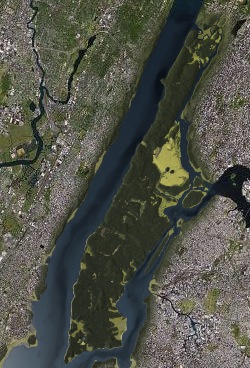
Recently, the Wildlife Conservation Society has put together Mannahatta, a website dedicated to providing a way of understanding the natural heart of the island of Manhattan. It is pretty impressive. At the heart of the project is an interactive map of that shows the island as it was in AD 1609. The map allows you to look at a specific location and see where it stood in the Native American inhabited landscape of the early 17th century just prior to the arrival of Henry Hudson and other Europeans.


200909281525.jpg

North American Luminescence Conference

I just signed up for the 6th biennial North American Luminescence Dating and Dosimetry Conference to be held in Seattle on October 22-24. ((To all my Seattle friends: I can't wait to see everyone.)) This year's conference is going to be hosted by Jim Feathers and his UW laboratory. Jim's work in luminescence sets the standard (extraordinarily high) for archaeological applications of luminescence and it will be worth the trip alone to hear what he and his lab are doing. As a bonus, the workshop features talks by luminescence experts doing work in geological applications -- such as high resolution dating of dune formation, etc. The cost is cheap: $28 for students, $55 for professionals. If you can make it, I recommend it.


Monday, September 14, 2009

More Ant Zombies

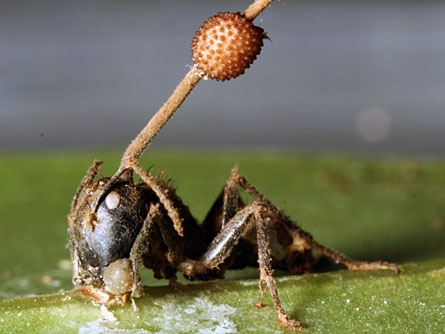
As reported in ScienceNews, an article in American Naturalist by Anderson et al (2009) documents the process by which fungus invades ants and turns them into zombies. http://www.sciencenews.org/view/generic/id/46184/title/Death-grip_fungus_made_me_do_it

sm_killerfungus_ant.jpg200909281528.jpg

The original article in AN:

Andersen, S. B., et al. 2009. The life of a dead ant: The expression of an adaptive extended phenotype. American Naturalist, 174, (September): 424-433.

As an aside, Dretske has been working on the question that plagues everyone ... "How do you know you are not a zombie." Of course, this puzzles me daily. Required reading.


Monday, August 24, 2009

Moai Model and Base Shape

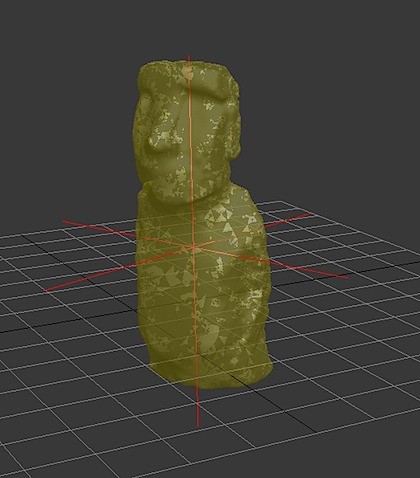
This is a see-through version of the moai that I've been working on. It is derived from a photosynth of a face-up fallen moai that is located along the south coast moai road (east of Charlie Love's excavation for those in the know). The redlines show the location of the center of mass.


200908241640.jpg

I'm now wondering whether the shape of the base has something to do the location of the center of mass and the general process of moving. Thinking about how tipping the statue to one side would make having a round front edge advantageous since the statue could effectively and smoothly "roll" along the front back and forth, minimizing friction, "rubbing" on the bottom, and making it easier to transfer the pendulum motion from one side to the other. Take a soda can, for example, and tilt it forward to a point before it tips over. If you rock the top of the can back and forth, the can will "roll" along its front edge and the shape of the travel will be along the shape of the curve of the bottom. Note that the front is the important part if the statues moves in that direction. Also note that the shape of the curve dictates how much of the statue makes contact with the ground at any point in time. The sharper the curve, the less surface area makes contact. The "flatter" the curve the greater the surface area.

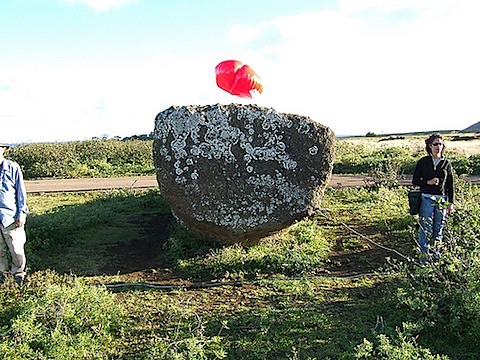
Consider this photo of the base of a moai from just outside of Rano Raraku. Matt and Deb are in the photo for scale positioned 5 meters from each other (as measured by the tape). It is a big statue. Here the shape of the base is circular towards the front one-half and more rectangular towards the back. The front curve is consistent with the "rolling" idea in the walking - small surface area during the rotation. The less curved sides also make sense since the greater length in contact with the ground means less pressure/surface area. This would avoid deadly pressure flakes that show up on "road moai" due to the gravity and the reflected force of the tilted statue on the welded tuff.


2443815074_83ede40fc9.jpg


Humanities and Education: Dehumanized

Dehumanized: When math and science ruled the school

Mark Slouka's recent article (September 2009) in Harper's Magazine makes some interesting observations about the nature of teaching in the humanities that that are thought provoking, useful and interesting. Slouka points out the clear value of humanities -- but also makes the point that not ALL humanities teaching is necessarily of value. Assessment clearly has a strong role here (i.e., are students more capable of thinking critical after they take a class or get a degree or not - or are they just "older"). He makes an excellent point that the importance of humanities is that they ARE value-laden and thus politically volatile. The point is that we need to be able to conceive of these values and understand their relation in terms of the world we want to live in. Instead, we get toothless introspection. His quote here is a good one about the restless futile inward debate that comprises much of the "social sciences": "Politically neuter, we now sing the politics of ocularcentric rhetroic. Safe in our tenured nests, we risk neither harm nor good." Ultimately, I think Slouka downplays the integrative role of mathandscience (as he puts it) and humanities (where it's not the former telling the latter what's what, but humanties using tolls from mathandscience to asses the degree to which we can get to our value-laden goals). But it's the fodder for some interesting thinking.

Saturday, August 22, 2009

Moai models II - Fallen statues walk again...

I've been working to build a model of a "transport" moai. These moai are found fallen on the roads that lead from Rano Raraku to areas across the island. Maps of these roads can be found at our http://www.rapanuidatabase.org via the downloadable KML files (and Google Earth). These statues are ones that have "failed" in transport -- for whatever reason, they toppled over and were not re-raised (largely impossible on big ones and any that could not be "excavated" back onto the landscape). Modeling a fallen moai is a key task since the ones that reached the ahu were often modified at that point to trim the bases and make them more upright (rather than tilted forward).

The hard part about doing this is that the statues are, by definition, fallen and thus are not easily photographed in 3 dimensions (unlike the upright ones). If a statue has fallen on its back, you get reasonable information about its front (and vice versa). I did my best with a statue that fallen on its back. You can view the photosynth of this moai here:

http://photosynth.net/view.aspx?cid=f895e1a6-cb75-4a24-b136-c79ee44d48eb

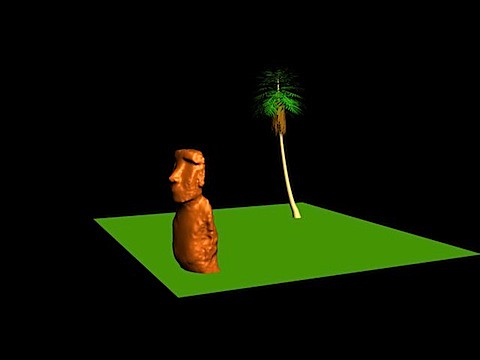
To generate the new model, I created a point cloud out of the photosynthed photos. I then used VRMesh - a trial version of a commercial software package -- to build a mesh object. It took a lot of tweaking to turn this into a watertight object given the noisy pointcloud and the lack of a backside for the moai. Then using AutoDesk 3ds Max (a 30-day evaluation copy), I turned the mesh into an object in a physical object. This is the result (below). The palm tree is in there just for goofs - it is not a jubea palm so not even remotely appropriate for Rapa Nui, but you only get a couple of choices...).

moai-standing.jpg  

Now I've got to figure out how to make the moai "move" in a physical realistic way. That is going to take learning a lot more about Autodesk 3ds Max - which is insanely complicated and probably vast overkill for what I'm trying to do (but, for 30days at least, it's free to try).

Using Autodesk 3ds Max, however, I can calculate the center of mass, though. This tells me, as I expected, that center of mass is forward, towards the leading edge of the bottom. The center of gravity is not, as I was thinking, low. In fact, the center is precisely in the middle of the moai. Why is this?

I think the answer is because that is where you would want it to be if you were going to "walk" the moai across the landscape in the inverted pendulum model. If you put the center of mass low, you would have a stable object, but rocking the object would take a great deal more energy since you'd have to move the top quite a bit before the low center of mass moved at all (imagine what would happen if it was a cone and the COM was basically even to the ground). Putting it higher allows the minimum amount of investment in tilting the object to get it to move. But if you put it too high, it would be really unstable and more likely to fall over. So the best solution, is to put it right in the middle.

Of course, this placement makes no sense at all if you moved the statue while it was horizontal and on a bunch of logs (as many might claim). In fact you'd probably want to have the center of mass closer to base to making standing it up easier. That way, you would have to invest the minimum amount of effort getting it tilted up before it "rights itself." Another clue to moai transport.